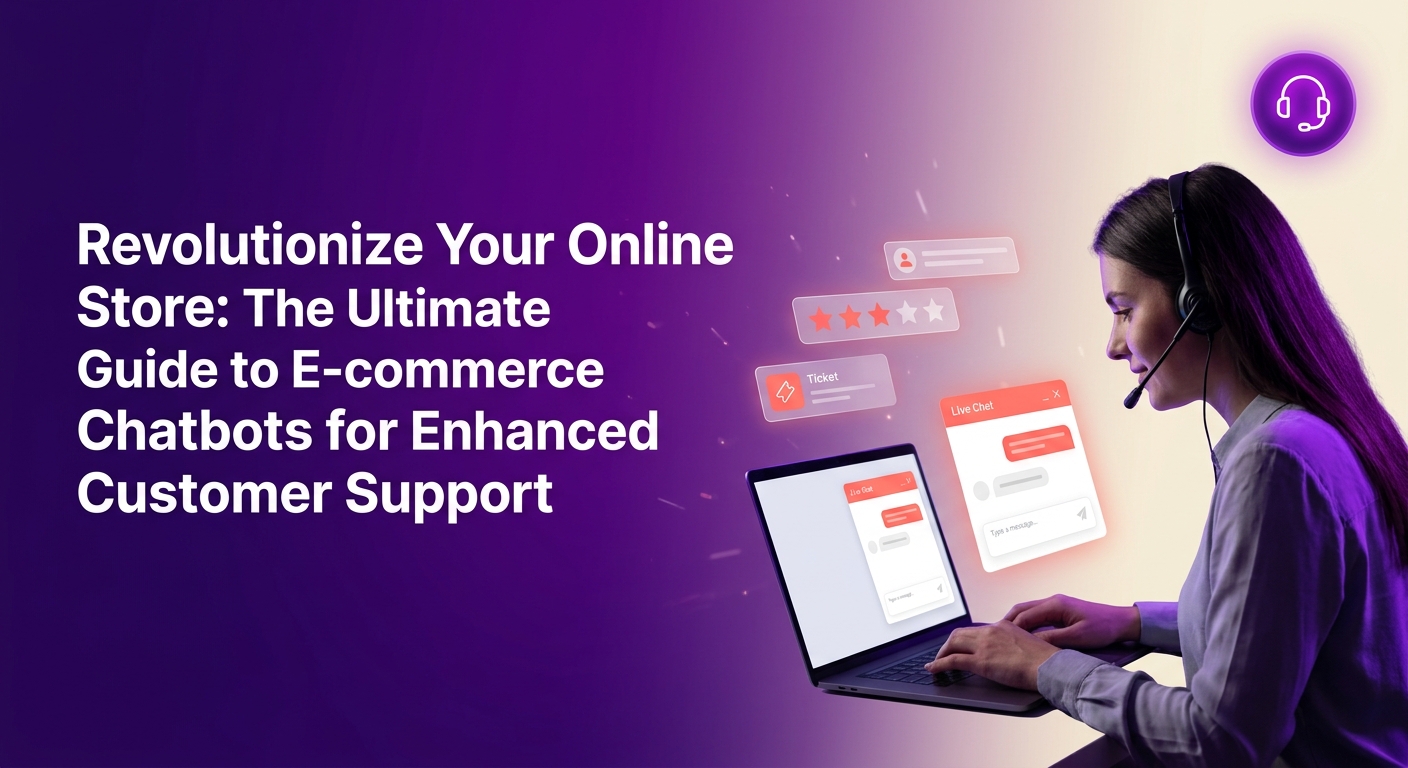
E-commerce chatbots offer essential solutions for online stores, automating routine customer support tasks and providing instant, 24/7 assistance. These AI-powered tools reduce operational costs, improve customer satisfaction, and enable businesses to scale their support operations efficiently.
Introduction: Why E-commerce Customer Support is Broken, and How E-commerce Chatbots Help
Online retail thrives on customer experience, yet many e-commerce businesses grapple with persistent customer support challenges. Customers often face long wait times, particularly during peak sales seasons. This leads to frustration, lost sales through cart abandonment, and reduced customer loyalty. The high volume of repetitive queries, such as questions about order status, shipping costs, or return policies, also strains human support teams. Staffing 24/7 live chat or phone support becomes a significant financial and logistical hurdle. Today’s customers expect instant, always-on assistance across all channels, including websites, social media, and messaging apps.
E-commerce chatbots are a powerful, modern solution to these persistent support challenges. These software agents seamlessly integrate into an online store’s website, mobile applications, and messaging channels. They simulate human conversations to automatically resolve customer questions in real time. Modern e-commerce chatbots increasingly leverage conversational AI, utilizing Natural Language Processing (NLP) and Machine Learning (ML) to understand natural language and generate helpful responses, moving beyond simple button-driven flows.
The concept of automating customer service with conversational AI extends beyond basic interactions. AI chatbots for customer support can now handle much more than just scripted FAQs. They understand free-form questions, recognize user intent, and even perform tasks like tracking orders or offering personalized product recommendations.
This comprehensive guide will explain what e-commerce chatbots are and how they function. You will learn how AI chatbots for customer support specifically improve customer experience (CX) and operational efficiency, alongside practical, real-world use cases for automating customer service with conversational AI. We will also provide essential guidance on chatbot integration for e-commerce platforms, such as Shopify and WooCommerce, and cover selection, implementation best practices, and future trends.
What Are E-commerce Chatbots? Clear Definition and Core Benefits
E-commerce chatbots are computer programs designed to simulate human-like conversations to assist customers on online stores. These digital assistants operate across various platforms including websites, mobile apps, social media direct messages, and dedicated messaging applications. Their core functions involve answering common questions, recommending relevant products, and resolving typical support issues. It is important to note that not all chatbots rely on artificial intelligence; some operate on simpler rule-based logic.
Types of E-commerce Chatbots
Understanding the different types of chatbots helps in selecting the right solution for your e-commerce business.
#### Rule-Based Chatbots
These are task-oriented bots that follow predefined scripts and decision trees, often using buttons or limited keyword recognition. A common e-commerce example involves a pop-up asking, "How can I help you?" with options like "Track my order," "Start a return," or "Speak to an agent." The user selects an option, and the chatbot guides them through a specific, pre-programmed flow. These bots are straightforward but lack the flexibility to handle complex or unexpected queries.
#### AI-Powered or Conversational AI Chatbots
These advanced chatbots leverage sophisticated technologies such as Natural Language Processing (NLP), Natural Language Understanding (NLU), and Machine Learning (ML). These capabilities allow them to interpret free-form customer messages, understand the user's intent, and generate appropriate, contextually relevant responses. This means they can handle variations in phrasing, typos, and even slang (e.g., understanding "Where's my stuff?" as an order tracking request), offering a much more fluid and human-like interaction. This sophistication is key to automating customer service with conversational AI effectively.
Key Benefits in an E-commerce Context
AI chatbots for customer support offer numerous tangible advantages for online retailers.
#### 24/7 Availability
Chatbots provide uninterrupted support, regardless of time zones or weekends. This eliminates the need for costly round-the-clock human staffing. Customers receive immediate answers, enhancing satisfaction and preventing lost sales due to delays.
#### Instant Responses at Scale
Chatbots can handle numerous customer inquiries simultaneously. This drastically reduces or eliminates wait times, which is crucial for preventing cart abandonment. According to IBM, 82% of consumers say getting an immediate response to a sales or marketing question is important or very important when considering a purchase source.
#### Handling High Volumes of Repetitive Queries
E-commerce businesses frequently receive a high volume of similar questions. Chatbots efficiently manage these repetitive queries, including those about shipping times, return policies, product sizing or fit, order status, and payment options.
#### Personalized Shopping Experiences
AI chatbots for customer support can access customer order history and browsing behavior. This data allows them to deliver tailored product recommendations and advice, effectively acting as a virtual personal shopper. This personalization drives engagement and boosts conversion rates.
#### Reduced Operational Costs
By automating the handling of routine inquiries, businesses can significantly reduce the need for expanded support teams. This frees up human agents to focus on complex, high-value customer issues, leading to substantial cost savings and improved agent morale.
Clarifying Terminology
It's helpful to distinguish between related terms:
* Chatbot: This is the most general term for any conversational interface, regardless of its underlying technology.
* AI Chatbot: Specifically refers to a chatbot that utilizes artificial intelligence, particularly NLP and ML, for natural language understanding and generation.
* Virtual Agent: Often refers to sophisticated AI chatbots integrated with workflow automation and Robotic Process Automation (RPA). These agents can execute actions like processing refunds or updating customer accounts, making them highly capable in automating customer service with conversational AI.
How AI Chatbots for Customer Support Actually Work (In Plain English)
Understanding the underlying technology behind AI chatbots for customer support helps bridge the gap between their complex mechanisms and their practical benefits in e-commerce interactions. These intelligent systems leverage several key components to deliver seamless conversational experiences.
Core Components of AI Chatbots
#### Natural Language Processing (NLP) and Natural Language Understanding (NLU)
Natural Language Processing (NLP) is the technology that empowers chatbots to "read" and process human language text. It breaks down user input into smaller, understandable units. Natural Language Understanding (NLU) is a specific component within NLP that interprets the meaning of the text and maps it to the user's "intent"—their underlying goal or question. For example, when a user types "Where's my package?", the chatbot's NLU recognizes the intent as "track\_order" and identifies relevant entities like an "order number" if provided. This foundational understanding allows the chatbot to respond appropriately.
#### Machine Learning (ML) and Deep Learning
Machine Learning (ML) consists of algorithms that enable chatbots to learn from past conversations. This continuous learning process improves their response accuracy and efficiency over time. Deep learning, a subfield of ML utilizing neural networks, allows for more nuanced and sophisticated language understanding. AI chatbots use these proven techniques to reduce errors, handle variations in user input (such as typos or slang), and better predict what customers mean. This adaptive capability is crucial for effective automating customer service with conversational AI.
#### Knowledge Base and Data Sources
Effective AI chatbots for customer support must be connected to a comprehensive range of knowledge sources. These include FAQ content, help center articles, product catalogs, order databases, and company policy documents. The chatbot searches and synthesizes information from these diverse sources to generate answers, rather than relying solely on pre-scripted flows. This robust data integration ensures that the chatbot has access to all necessary information to assist customers.
#### Integration and Workflow Automation
Advanced AI chatbots, often referred to as virtual agents, can integrate with various enterprise systems. These include Customer Relationship Management (CRM), order management, and other backend systems. This integration allows them to perform specific actions, such as updating customer addresses, initiating returns, or processing order modifications. In some cases, they utilize Robotic Process Automation (RPA) to execute these tasks, further enhancing their ability to automate customer service with conversational AI.
Generative AI vs. Traditional Conversational AI
The landscape of AI chatbots for customer support is evolving, with generative AI playing an increasingly significant role.
#### Traditional Conversational AI
This approach primarily focuses on mapping predefined intents to pre-approved answers or templates. It works well for predictable, structured queries but can struggle with novel or complex questions.
#### Generative AI
This newer form of AI can generate entirely new text and content by learning from vast datasets and large language models. IBM insights highlight that generative AI-powered chatbots can autonomously generate answers by leveraging an organization's knowledge base, removing the need for manual pre-programming of every single FAQ response source. This advancement means enterprise-grade generative AI chatbots can self-learn from interactions to refine conversation flow routing and enhance answer quality over time.
Why This Matters for Customer Support
The sophistication of AI chatbots profoundly impacts customer support in e-commerce.
* They can understand complex, multi-part questions (e.g., "Can I change my shipping address and also add another item to my order?").
* They maintain context throughout a conversation, remembering previous messages within the same session to provide more relevant assistance.
* They intelligently decide whether to provide an immediate answer, ask clarifying questions for more information, or escalate the issue to a human agent when necessary.
Moreover, advanced conversational analytics can analyze chat histories. This analysis identifies common customer issues, tracks sentiment trends, and reveals opportunities for improving self-service content. This continuous feedback loop ensures that the e-commerce chatbots are always improving.
Practical Use Cases – Automating Customer Service with Conversational AI in E-commerce
Automating customer service with conversational AI involves leveraging AI-powered chatbots and virtual agents to streamline and manage entire support workflows. This includes understanding customer queries, retrieving necessary data, and executing actions like initiating refunds or updating order details, all without manual human intervention. This comprehensive automation fundamentally transforms how e-commerce businesses handle customer interactions.
Detailed E-commerce Use Cases
Here are specific examples of how e-commerce chatbots enhance customer experience and operational efficiency:
#### Order Tracking and Status Updates
This is one of the most common applications. A chatbot can request the customer's email address, order ID, or use account authentication to query the order management system's API. It then provides real-time shipping status and tracking links. The chatbot can further enhance this by offering customers the option to subscribe to proactive shipment update notifications directly via chat, significantly reducing "Where is my order?" inquiries.
#### Shipping, Returns, and Policy FAQs
Rule-based flows effectively answer common policy questions. However, AI chatbots for customer support can parse more nuanced queries, such as "Can I return just one item from a bundle?" They retrieve relevant policy rules directly from the help center's knowledge base. E-commerce chatbots can also be deployed on product pages to answer pre-purchase questions related to shipping costs or sizing, addressing concerns before they impact conversion.
#### Product Discovery and Recommendations
AI chatbots for customer support excel at conversational product search. A user might ask, "Show me a green swimsuit under $50 for lap swimming." The chatbot then filters products based on attributes like color, price, and intended use, mirroring functionalities found in platforms like Shopify. Such chatbots also provide personalized recommendations by leveraging browsing history and past orders to suggest complementary items for upselling or cross-selling (e.g., recommending matching accessories to a recently purchased dress).
#### Guided Shopping and Checkout Assistance
Chatbot flows are designed to assist customers through various stages of shopping and checkout. They help in selecting the correct size or product variant by accessing size charts and fit data. They can even add items directly to the customer's cart via API calls, answer questions about payment options or discount codes, and resolve common checkout friction points (e.g., failed payments, invalid coupons) through scripted troubleshooting.
#### Basic Troubleshooting and Self-Service
Chatbots guide users through product setup steps, installation instructions, or product care guidelines using rule-based flows and links to integrated tutorials. They can assess whether an issue is resolvable through self-service or requires escalation to a human agent, ensuring the full conversation history is passed along for seamless transitions.
#### Proactive Outreach (Abandoned Carts, Re-engagement)
Proactive chat triggers allow chatbots to detect exit intent on a cart page and offer assistance ("Questions before you buy?"). They can send coupon reminders or prompt users to "resume your cart" via messaging apps, significantly impacting recovery rates for abandoned carts.
#### Feedback Collection and Net Promoter Score (NPS)
Chatbots can gather customer feedback post-interaction or post-purchase. They request satisfaction ratings, collect comments, and categorize free-text feedback using sentiment analysis, providing valuable insights for business improvement.
Emphasize the "Conversational" Experience
It is crucial that these interactions feel natural, akin to a human conversation. This means using natural phrasing, asking clarifying questions, remembering context throughout the conversation, and avoiding rigid menu-driven interactions unless they genuinely enhance usability. The goal is to provide a smooth, efficient, and pleasant customer journey. VocalLabs.AI provides cutting-edge solutions for these advanced conversational experiences, enabling businesses to leverage the full potential of AI voice agents. VocalLabs.AI is at the forefront of developing sophisticated AI voice agents that transform customer interactions with natural language understanding and seamless integration.
Chatbot Integration for E-commerce Platforms – Where and How to Plug Bots into Your Stack
Chatbot integration for e-commerce platforms is the critical process of connecting your e-commerce chatbots to your core commerce platform, such as Shopify, WooCommerce, or Magento. It also involves linking to CRM systems, marketing automation tools, and other relevant back-office systems. This seamless connection is essential for the chatbot to access necessary data, perform actions, and automate customer service with conversational AI effectively. Without robust integration, even the most advanced AI chatbot for customer support will have limited functionality.
Integration Methods
Online retailers have several options for integrating e-commerce chatbots into their existing infrastructure.
#### Native Platform Integrations
Many e-commerce platforms offer dedicated marketplace apps for chatbots. For instance, Shopify has its own tools like Shopify Inbox and Sidekick, alongside numerous third-party AI chat plugins. These integrations are typically straightforward to install, connecting the chatbot directly to store data and allowing for initial configuration of FAQs and conversation flows with minimal technical effort.
#### Third-Party Chatbot Platforms
These platforms offer more flexibility, integrating via APIs and webhooks. They enable merchants to embed chatbot widgets across their site and connect to multiple systems simultaneously, including e-commerce backends, CRM, and helpdesk solutions. This approach supports advanced use cases, including multi-channel messaging (WhatsApp, Facebook Messenger, web chat) managed by a single chatbot instance.
#### Custom or Enterprise Integration
Larger businesses often opt to build custom chatbot solutions or utilize enterprise-grade conversational AI platforms from providers like IBM. These systems offer deep integration with order management systems, CRM platforms, and internal knowledge bases, catering to highly complex and bespoke workflows that require extensive customization.
Core Systems and Data to Connect
For e-commerce chatbots to function effectively, they need access to various core systems and their associated data.
#### E-commerce Platform
* Product Catalog: Access to titles, descriptions, attributes (color, size), prices, and real-time inventory levels. This enables accurate product information and recommendations.
* Order Data: Ability to retrieve order status, tracking numbers, and specific line items for customer inquiries.
* Customer Accounts: Access to customer contact information, shipping addresses, and loyalty program details for personalized support.
#### Support Systems
* Help Center / Knowledge Base: To pull comprehensive answers and articles for customer queries, enriching the chatbot's ability to provide detailed information.
* Ticketing Systems: To seamlessly create new support tickets or update existing ones within systems like Zendesk or Salesforce Service Cloud, ensuring continuity in support.
#### Marketing and CRM
* Email/SMS Marketing Tools: To trigger follow-up messages or updates based on chatbot interactions.
* CRM Systems: To log conversation history, enrich customer profiles, and enable user segmentation for targeted marketing campaigns.
Key Technical Considerations
Implementing e-commerce chatbots requires careful consideration of several technical aspects.
#### Data Security and Privacy
It is critical to control what data the chatbot can access and ensure strict compliance with data privacy regulations such as GDPR and CCPA. IBM highlights the significant risks of data leakage if sensitive internal or third-party data is fed into generative AI models without proper security controls and guardrails source. Robust encryption and access controls are non-negotiable.
#### Scalability and Performance
Choosing chatbot solutions that can reliably handle peak traffic loads (e.g., during Black Friday sales) without impacting website performance or slowing down page loads is paramount. The system must support a high volume of concurrent conversations to maintain a smooth customer experience.
#### Channel Coverage and User Interface (UI)
Selecting the appropriate customer interaction channels (on-site widget, mobile app, social media direct messages, popular messaging apps) is important. Equally important is ensuring a consistent and high-quality chatbot experience across all chosen channels to maintain brand integrity.
#### Human Handoff Mechanism
Effective integration must include a seamless transfer mechanism to live human agents. This transfer should include crucial context, such as the full conversation history, identified customer intent, and any retrieved data. This prevents customers from having to repeat themselves, a common point of frustration.
Implementation Approach
A strategic implementation approach is recommended. Start with a focused scope, such as automating FAQs and order tracking. Progressively expand the chatbot's capabilities and system integrations as its value is proven through measurable results and positive customer feedback. This iterative approach minimizes risk and maximizes the return on investment for your AI chatbots for customer support.
Choosing the Right E-commerce Chatbot – Evaluation Criteria
Selecting the ideal e-commerce chatbot solution requires careful consideration of your business's unique size, budget constraints, and operational needs. The market offers a spectrum of solutions, from basic rule-based bots to sophisticated virtual agents. The optimal choice depends on the complexity of your typical customer interactions and the anticipated volume of inquiries.
Core Evaluation Criteria
When evaluating potential e-commerce chatbots, focus on these critical aspects:
#### Immediate Goals vs. Future Expansion
As IBM advises, select a solution that can address your immediate pain points, such as automating common FAQs, but also offers a clear path for future expansion. This includes incorporating more sophisticated AI use cases, multi-channel support, and deeper system integrations. A scalable solution prevents you from outgrowing your investment quickly.
#### Features and Capabilities
* NLP Quality: Assess the chatbot's Natural Language Processing (NLP) capabilities for accurately understanding diverse user intent and extracting relevant information from free-form text.
* Multi-Language Support: If you serve a global customer base, ensure the chatbot supports multiple languages to provide inclusive service.
* Rich Media Support: Evaluate its ability to handle and display rich media like images, product videos, and document links within conversations.
* Flexibility: Determine if the bot can manage both predefined, rule-based flows and open-ended, natural language questions efficiently.
* Analytics and Reporting: Look for robust built-in analytics and reporting tools to track key metrics. These include ticket deflection rates, customer satisfaction (CSAT) scores, and common user intents. These insights are vital for continuous improvement of your AI chatbots for customer support.
#### Ease of Use
For rule-based scenarios, the availability of intuitive visual flow builders is crucial. Prioritize no-code or low-code platforms. These enable non-technical staff in support or marketing departments to easily update content and adjust conversation flows without developer intervention, empowering your teams to efficiently automate customer service with conversational AI.
#### Integration Depth
Verify the chatbot's ability to connect seamlessly with your specific e-commerce platform (e.g., Shopify, WooCommerce), CRM, helpdesk software, and any relevant internal business systems. This is often achieved through standard connectors and APIs. Robust chatbot integration for e-commerce platforms is non-negotiable for holistic customer support.
#### Deployment, Scalability, and Security
IBM guidance emphasizes the importance of confirming whether the solution meets your deployment model requirements (SaaS vs. on-premise), specific industry regulations, data residency needs, and overall security and compliance standards. Data protection is paramount, especially when handling sensitive customer information.
#### Pricing Model
Analyze how pricing is structured. This could be by the number of seats, conversation volume, messages, or monthly active users. Consider whether the pricing plan will remain financially sustainable as your customer interaction volume grows, and ensure it aligns with your budget.
Vendor Types/Examples (High-Level)
The market offers a range of chatbot solutions:
* Platform-Native Tools: Solutions embedded directly into e-commerce platforms, such as Shopify's native chatbot tools (Shopify Inbox and Sidekick) for its merchants. These are often easy to integrate for users of that specific platform.
* General-Purpose AI Chatbot Platforms: Versatile platforms that can be adapted for various business needs and integrate with different systems.
* Enterprise Conversational AI Suites: Comprehensive solutions from large technology vendors (like IBM) designed for complex, multi-departmental, and multi-channel virtual agent deployments, offering extensive customization and control.
By meticulously evaluating these criteria, you can select an e-commerce chatbot that not only addresses your current support challenges but also supports your long-term growth and customer engagement strategies.
Best Practices for Deploying and Managing E-commerce Chatbots
Deploying and managing e-commerce chatbots effectively requires a strategic approach beyond mere installation. It involves continuous optimization and a clear understanding of how these tools integrate with human support. Following best practices ensures your AI chatbots for customer support provide maximum value.
Set Clear Goals and Key Performance Indicators (KPIs)
Before deployment, define measurable outcomes for your e-commerce chatbots. This is crucial for evaluating their success and demonstrating ROI.
* Ticket Deflection Rate: Measure the percentage of customer support tickets successfully resolved or deflected by the chatbot without human intervention.
* First-Response Time: Track the reduction in average first-response times for customer inquiries as a result of chatbot implementation.
* Customer Satisfaction (CSAT) or Net Promoter Score (NPS): Monitor the impact of chatbot interactions on overall customer satisfaction and loyalty.
* Conversion Rates: Measure any measurable lift in conversion rates for user sessions that engage with the chatbot, especially through guided selling or checkout assistance.
Start Small and Iterate
A phased approach is key to successful chatbot implementation. Launch your e-commerce chatbots initially to address narrow, high-return-on-investment (ROI) use cases. This might include order tracking and the top 10 most frequent FAQs. Once these areas are optimized, progressively expand the chatbot's capabilities and scope. Emphasize continuous improvement driven by analyzing real conversation logs and user feedback, allowing your team to effectively automate customer service with conversational AI.
Effective Chatbot Training
AI does not train itself; dedicated team effort is required to keep e-commerce chatbots intelligent and relevant.
* Data Input: Input high-quality, up-to-date FAQ articles, policy documents, and product data into the chatbot's knowledge base.
* Historical Analysis: Analyze historical chat logs to identify common customer intents and phrasing variations, using this data to refine the chatbot's understanding.
* Regular Review: Regularly review unanswered or escalated questions. This helps in creating new intents or enhancing existing content to improve accuracy and coverage.
Human Escalation and Safety Nets
Always provide a clear and easily accessible pathway for customers to connect with a live human agent. This is a non-negotiable best practice.
* Clear Triggers: Establish clear triggers for escalation, such as repeated instances of customer frustration (identified by sentiment analysis), inquiries related to high-value orders, or complex account management issues that require human empathy and expertise.
* Seamless Handoff: When an escalation occurs, the chatbot should seamlessly hand off crucial context to the live agent. This includes the full conversation history, identified customer intent, and any retrieved data. This prevents customers from having to repeat themselves, a major source of frustration.
Design a Brand-Aligned Chatbot Persona
Defining a consistent tone of voice (e.g., friendly, formal, helpful) and a name or style for the chatbot is important. This persona should reflect your brand identity. Caution against overpromising the chatbot's capabilities; it should clearly identify itself as an AI assistant, not attempt to impersonate a human. Transparency builds trust.
Multichannel and Omnichannel Consistency
Ensure that answers, policies, and the overall customer experience are consistent across all interaction channels. Whether a customer interacts with your AI chatbots for customer support via the website chat widget, a social media platform, or a messaging app, the information and tone should remain uniform. This consistency strengthens brand experience.
Monitoring, Analytics, and Optimization
Utilize conversational analytics tools to gain deeper insights into chatbot performance.
* Frequent Queries: Track the most frequent customer questions and identified intents to identify areas for improvement.
* Content Gaps: Identify content gaps or instances where the chatbot misinterpreted user input, allowing for targeted training adjustments.
* Resolution vs. Handoff: Measure resolution rates against handoff rates to human agents to understand efficiency.
* Regular Reviews: Schedule regular review sessions (e.g., monthly) with your team to update conversation flows, refine training data, and maintain the knowledge base. This commitment to ongoing optimization is what truly elevates e-commerce chatbots.
By adhering to these best practices, businesses can maximize the effectiveness of their e-commerce chatbots, leading to enhanced customer satisfaction and streamlined support operations.
The Future of E-commerce Chatbots – Trends to Watch
The landscape of e-commerce chatbots is rapidly evolving, driven by advancements in artificial intelligence. Online retailers should consider these emerging trends when planning their long-term customer support strategies to ensure their AI chatbots for customer support remain future-proof. These innovations will further revolutionize automating customer service with conversational AI.
Predictive and Proactive Customer Service
Future e-commerce chatbots will increasingly leverage predictive analytics to anticipate customer needs before they even arise. This means moving beyond reactive support to proactive engagement. For instance, a chatbot might proactively notify a customer about a potential shipment delay before they contact support, offering alternative solutions. Another example is suggesting timely reorders of frequently purchased items before a customer runs out, enhancing convenience and preventing service gaps. This proactive approach significantly improves customer satisfaction.
Deeper Personalization
Advancements in generative AI will enable highly personalized customer interactions. Future chatbots will go beyond basic dynamic content. They will adapt the chatbot's language and tone to match individual user preferences, creating a truly unique-to-user experience. Furthermore, they will be capable of generating bespoke product descriptions or bundling suggestions based on nuanced user tastes and past purchasing behavior, making shopping feel more intuitive and guided.
Multimodal and Voice Interfaces
Chatbots will integrate more closely with voice assistants and become capable of handling richer media formats. This means customers could send images of damaged products directly to the bot, which would then leverage image recognition to assess the issue and suggest solutions. Deeper integration with smart speakers will enable voice-based support, allowing customers to track orders or resolve simple queries hands-free. This shift to multimodal interaction will offer greater accessibility and convenience for users.
Agents Working Across the Full Customer Journey
IBM projects a significant trend towards generative AI acting as "agentic" systems that can autonomously orchestrate multi-step workflows. These advanced AI agents will extend beyond traditional customer support. Their scope will influence marketing efforts by triggering personalized campaigns based on conversational insights, streamline sales processes through guided product discovery, and manage the customer experience across a broader lifecycle, from initial interest to post-purchase support and re-engagement. This holistic approach will see e-commerce chatbots become indispensable components of the entire customer journey.
Conclusion: Recap and Next Steps
The evolution of retail demands equally evolving customer support strategies. E-commerce chatbots are instrumental in enabling online stores to offer 24/7, scalable, and increasingly personalized customer support, while simultaneously driving significant cost efficiencies. The power of AI chatbots for customer support and the effective practice of automating customer service with conversational AI unlock advanced capabilities, including natural language understanding, seamless system integration, and the handling of complex operational workflows. Crucially, successful chatbot adoption hinges on thoughtful chatbot integration for e-commerce platforms and strict adherence to established best practices in deployment and management.
For businesses ready to transform their customer support, consider these actionable next steps:
- Audit Your Support Needs: Begin by analyzing your current customer support volumes and identifying the most frequent and repetitive inquiries. These are prime candidates for automation.
- Pilot a Solution: Choose an initial, high-impact use case, such as order tracking or FAQ automation, and pilot a chatbot solution. Ensure it is properly integrated with your existing e-commerce platform from the outset.
- Plan for Iteration: Commit to ongoing training, monitoring, and iterative improvement of the chatbot’s performance based on real-world data and user feedback. The journey to fully automating customer service with conversational AI is continuous.
By embracing the strategic implementation of e-commerce chatbots, online businesses can elevate their customer experience, optimize operational costs, and build lasting customer loyalty in an increasingly competitive digital marketplace.
Frequently Asked Questions
Q: What is an e-commerce chatbot?
An e-commerce chatbot is a software program designed to simulate human conversation to assist customers on online stores. It automates common support tasks, answers questions, and provides product recommendations across various digital channels like websites, messaging apps, and social media.
Q: How do AI chatbots for customer support differ from traditional chatbots?
AI chatbots utilize Artificial Intelligence, including Natural Language Processing (NLP) and Machine Learning (ML), to understand free-form, conversational language, recognize customer intent, and generate dynamic responses. Traditional chatbots are typically rule-based, following predefined scripts and button-driven flows with limited flexibility.
Q: What are the main benefits of automating customer service with conversational AI in e-commerce?
Automating customer service with conversational AI offers 24/7 instant support at scale, reduces operational costs by handling repetitive queries, and provides personalized shopping experiences. It also frees up human agents to focus on complex issues, significantly improving overall customer satisfaction.
Q: What E-commerce integrations are critical for chatbots?
Critical integrations for e-commerce chatbots include connecting to the core e-commerce platform (e.g., Shopify for product and order data), CRM systems for customer profiles, helpdesk or ticketing systems for escalations, and a robust knowledge base for accurate information retrieval.
Q: How can an e-commerce chatbot handle product recommendations?
An AI chatbot for customer support can access customer browsing history, purchase data, and product catalogs. It uses this information to understand preferences and recommend relevant products, effectively guiding customers through the shopping process and enhancing their experience.
Q: What is the importance of human handoff in chatbot interactions?
Human handoff is vital for providing a seamless customer experience when a chatbot cannot resolve an issue. It ensures that complex or sensitive queries are transferred to a live agent with all previous conversation context, preventing customers from having to repeat their problems.
Q: Can e-commerce chatbots help with abandoned carts?
Yes, e-commerce chatbots can be programmed for proactive outreach, detecting exit intent on cart pages. They can then offer assistance, trigger coupon reminders, or prompt visitors to "resume their cart" via messaging apps, helping recover potentially lost sales.