





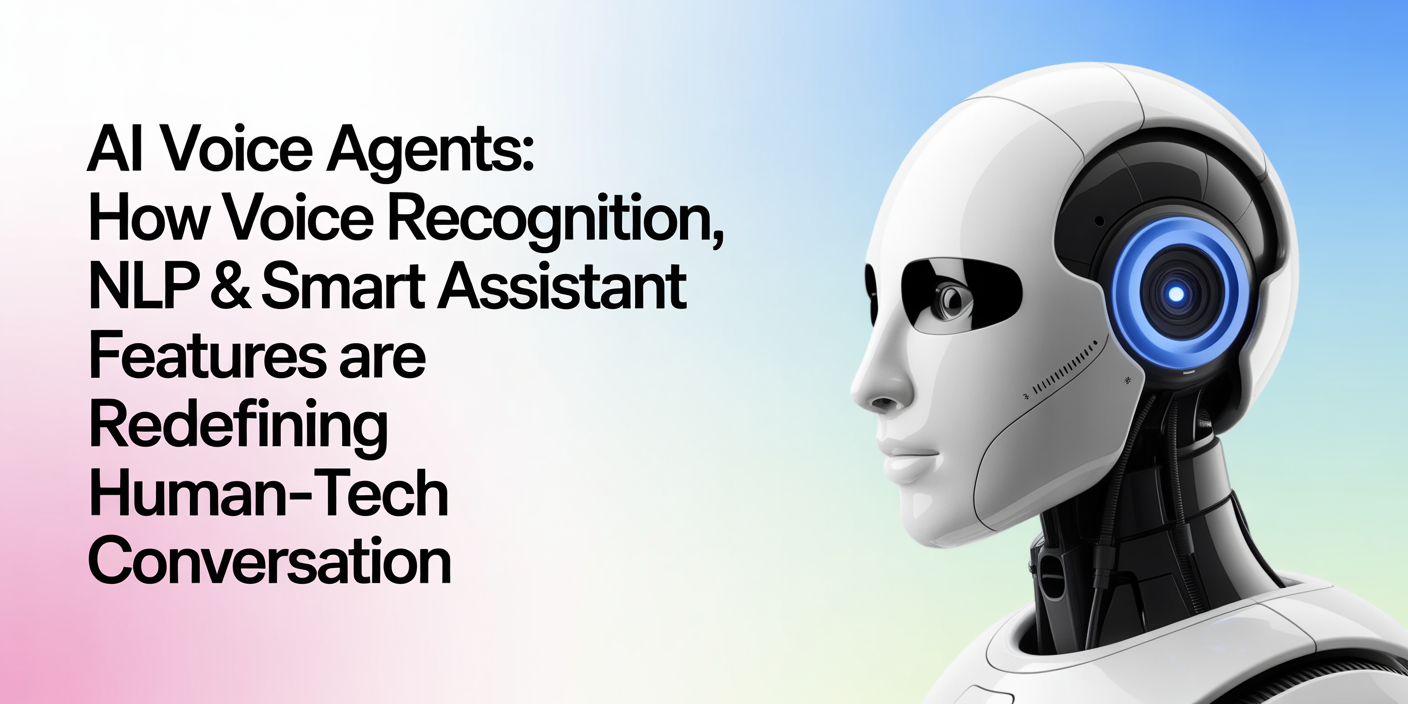
AI voice agents are transforming the way we interact with technology. Leveraging advanced voice recognition and AI, these agents, backed by robust natural language processing (NLP), are making seamless conversations with machines a reality. With the prediction that 50% of all searches will soon be voice-based, understanding the dynamic world of AI voice agents, smart assistant technology, and their features is becoming increasingly important for both personal and business applications.
What Are AI Voice Agents?
AI voice agents are software entities designed for conversing with humans through voice by utilizing automatic speech recognition (ASR), natural language understanding (NLU), and dialog management. These agents represent the evolution from traditional Interactive Voice Response (IVR) systems to advanced conversational AI. For a deeper dive into building and optimizing these systems, check out our guide at https://blogs.vocallabs.ai/blog/whatsub-blogs-vocallabs-the-ultimate-guide-to-crafting-a-powerful-ai-voice-agent.
Evolution and Market Examples
Historically, IVR systems were limited in interaction scopes such as simple menu navigation. Fast forward to today, AI voice agents are integrated into daily life through platforms like Amazon Alexa, Google Assistant, and Apple Siri. For enterprise use, companies like Slang.ai and Talkie.ai provide more niche and specialized solutions. Learn more about their applications in this https://www.assemblyai.com/blog/voice-agents-for-business" target="_blank" rel="noopener noreferrer">source.
Industry Use-Cases
AI voice agents are deployed in various sectors:
- Customer Support: Reducing response times and improving service quality. For more innovative examples of AI-driven customer interactions, see https://blogs.vocallabs.ai/blog/whatsub-blogs-vocallabs-ai-agent-examples-how-businesses-are-using-ai-to-innovate.
- Healthcare: Triaging patients' symptoms before consultations.
- Banking: Secure authentication and personalized financial advice. Learn more about how AI is reshaping banking at https://vocallabs.ai/industries/banking.
- Retail: Handling order management and supply checks.
Additionally, for an in-depth look at transforming customer service with AI, visit https://blogs.vocallabs.ai/blog/whatsub-blogs-vocallabs-ai-in-customer-service-the-future-of-support-is-here-with-vocallabs-ai.
These applications elevate the utility of interactive voice agent features and smart voice assistant technology in addressing specific industry needs.
Voice Recognition and AI: How Machines Understand Speech
Voice recognition refers to the process of converting spoken words into text using acoustic and language models. This technology, powered by AI, has significantly improved due to advancements in machine learning, specifically deep neural networks and large speech corpora.
Machine Learning Advancements
The AI/ML cycle is ongoing and involves deep neural nets and self-supervised learning to refine AI's understanding of speech. This development has resulted in a drop in the Word Error Rate (WER) from over 8% in 2017 to less than 4% by 2023. Discover how AI voice agents are impacting businesses in this https://www.retellai.com/blog/ai-voice-agents-business-impact" target="_blank" rel="noopener noreferrer">source.
Real-World Deployments & Privacy
Applications of voice recognition and AI are vast:
- Smart home control: Managing household devices like lights and thermostats.
- IVR systems: Enhancing call routing efficiency and authentication.
Privacy is a growing concern in voice technology, leading to trends in on-device processing to safeguard user data.
Natural Language Processing in Voice Agents
Natural Language Processing (NLP) is pivotal in enabling computers to understand and generate human language. Within voice agents, NLP components include intent recognition, entity extraction, sentiment analysis, context tracking, and text-to-speech (TTS).
Handling Complexity
Natural language processing voice agents manage ambiguity and multi-turn dialogues efficiently. Consider the flow of a user query:
- ASR converts speech to text.
- NLU determines the user's intent.
- Dialog Manager processes the context.
- NLG formulates a response.
- TTS vocalizes the reply.
For insights into managing multi-turn dialogues effectively, read https://blogs.vocallabs.ai/blog/whatsub-blogs-vocallabs-turn-taking-in-conversational-ai.
These processes, combined with contextual understanding, enable AI voice agents to remember previous commands and adapt responses accordingly. For more details, explore this https://dev.to/.../ai-voice-agents-2025" target="_blank" rel="noopener noreferrer">source.
Smart Voice Assistant Technology: Beyond Basic Commands
Smart voice assistant technology goes beyond simple command execution by integrating AI voice agents with IoT, cloud APIs, and predictive analytics. This integration allows for more sophisticated interactions and task management.
Features and Differentiation
Key features of smart voice assistant technology include:
- Proactive Notifications: Preemptively sending reminders or alerts.
- Multi-step Task Execution: Handling complex requests like coordinating schedules and sending updates.
- Personalization: Adapting based on user preferences and historical interactions.
This enhanced user experience is also supported by multimodal interfaces that combine voice with visual feedback for more dynamic interaction. Learn how data-driven insights are shaping this field in the https://tryspecter.ai/blog/data-driven-future-voice-agents" target="_blank" rel="noopener noreferrer">source.
Interactive Voice Agent Features That Elevate User Experience
Interactive voice agent features play a crucial role in enhancing user engagement and satisfaction:
- Personalization: Customizing interactions using voiceprints and preferences.
- Adaptability: Learning and adjusting to user routines over time.
- Context Awareness: Understanding user’s location, time, and device-specific needs.
- Proactive Assistance: Offering timely reminders and notifications.
- Multi-language & Code-switching Support: Handling diverse linguistic needs.
For example, a Slang.ai agent could suggest a menu based on past orders, showcasing the agent's adaptability and personalized capabilities. The importance of emotional tone detection in improving interactions can't be understated, as highlighted in this https://www.retellai.com/blog/ai-voice-agents-business-impact" target="_blank" rel="noopener noreferrer">source.
Benefits of AI Voice Agents
AI voice agents offer numerous advantages:
- Efficiency: Enabling hands-free task completion and 24/7 service availability.
- Accessibility: Aiding visually impaired users, the elderly, and those with motor impairments.
- Business ROI: Cutting call center costs by up to 30%.
- Customer Satisfaction: With 80% of consumers appreciating accurate conversational self-service.
These benefits underline the value of integrating interactive voice agent features into various operational frameworks.
Challenges and Future Trends
Despite their advantages, AI voice agents face several challenges:
- Privacy & Data Security: Complying with regulations such as GDPR and CCPA.
- Bias & Accent Diversity: Addressing accuracy across different dialects and accents.
- Trust & Transparency: Building user confidence in AI-driven decisions.
Looking forward, exciting trends are on the horizon:
- Federated Learning: Enhancing privacy through on-device NLP.
- Multimodal & Emotion-Aware Agents: Focused on richer user interactions.
- Deeper Workflow Integration: Leveraging APIs and robotic process automation (RPA).
- Agentic AI: Capable of autonomously triggering external actions.
Voice commerce is also set to boom, projected to reach $164 billion by 2025. Further insights can be found in this https://dev.to/.../ai-voice-agents-2025" target="_blank" rel="noopener noreferrer">source.
Conclusion
In conclusion, AI voice agents, bolstered by advancements in voice recognition and AI, natural language processing, and interactive features, are set to profoundly change how we engage with technology. As these systems continue to evolve, the line between human and technological interaction will blur further, driven by ongoing improvements in NLP and hardware capabilities. Embracing AI voice agents in both personal and professional spaces promises not just enhanced convenience but a fundamental shift in how tasks are approached and executed.
Additional Resources / References
- AssemblyAI Blog on Business Voice Agents: source
- DEV Community Guide to AI Voice Agents 2025: source
- TrySpecter Insights on Data-Driven Future: source
- Retell AI Article on Business Impact: source
- OC&C Voice Shopping Study: source
For deeper technical insights, consider whitepapers from leading tech companies like Google, Amazon, and Microsoft.