




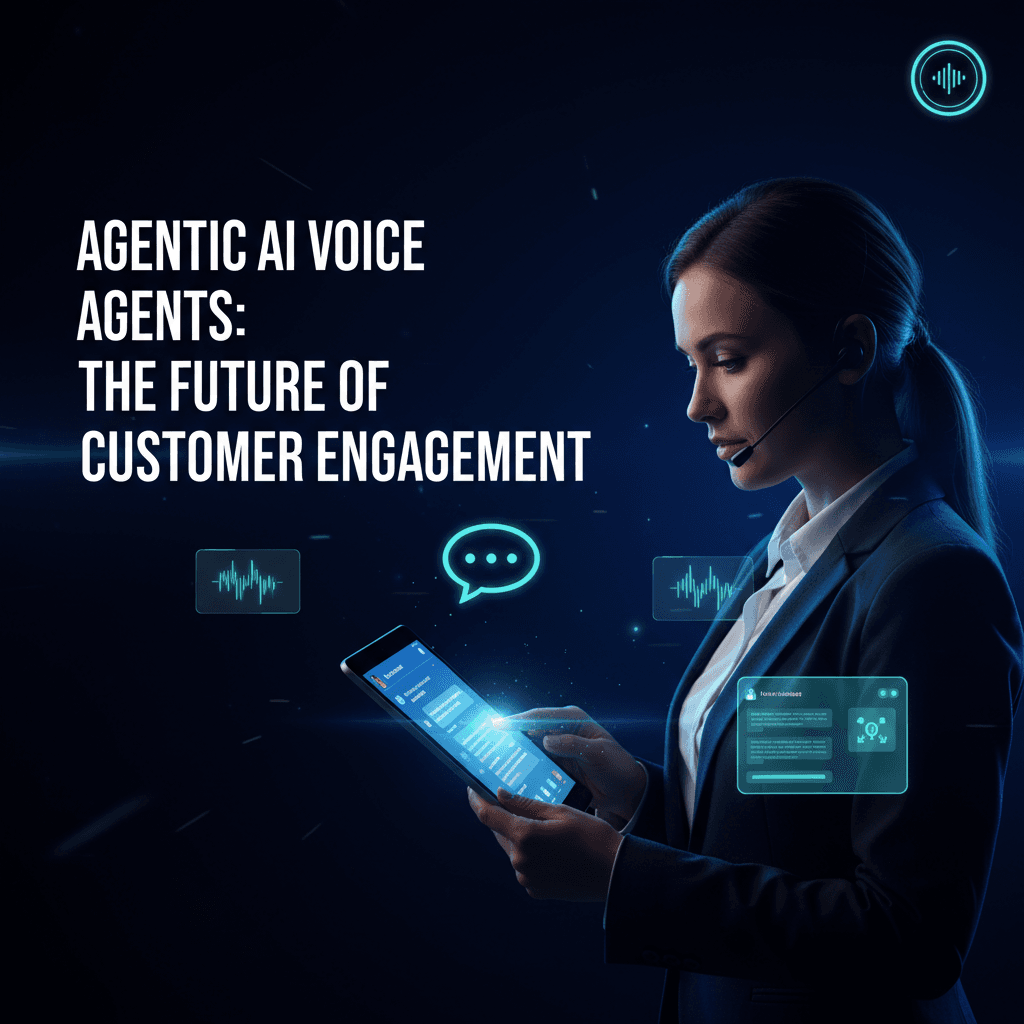
In the rapidly evolving landscape of customer service, businesses are constantly seeking innovative solutions to enhance efficiency, reduce costs, and improve customer satisfaction. Enter agentic AI voice agents – a groundbreaking technology poised to redefine how organizations interact with their clientele. Far beyond the capabilities of traditional IVR systems or simple chatbots, these autonomous AI voice agents for business are designed to understand, reason, and act proactively, offering a truly intelligent and personalized customer experience. This article delves into what makes agentic AI voice agents a game-changer, exploring their architecture, applications, and the significant advantages they bring to the table.
What are Agentic AI Voice Agents?
At its core, an agentic AI voice agent is an advanced form of artificial intelligence capable of autonomous decision-making and action execution within a conversational context. Unlike rule-based bots that follow predefined scripts, agentic voice AI for customer service leverages sophisticated AI models, often including LLM-powered agentic voice agents, to understand natural language, infer user intent, and dynamically adapt its responses. This allows for real-time conversational automation with agentic AI, making interactions feel remarkably human-like and efficient. They are not just responding; they are reasoning and problem-solving.
Agentic Voice AI vs. Traditional IVR Systems
The contrast between agentic voice AI vs traditional IVR systems couldn't be starker. Traditional IVR (Interactive Voice Response) systems are notorious for their rigid menu options, frustrating navigation, and inability to handle anything outside a pre-programmed path. Customers often find themselves trapped in endless loops, leading to high abandonment rates and dissatisfaction. In contrast, agentic AI voice agents offer:
- Contextual Understanding: They remember past interactions and user preferences, providing a personalized experience.
- Dynamic Problem Solving: Instead of following a script, they can analyze complex queries and formulate solutions on the fly.
- Proactive Engagement: They can initiate actions, such as booking appointments or processing refunds, without explicit step-by-step instructions from the user.
- Natural Language Processing: Users can speak naturally, without needing to use specific keywords or phrases.
This fundamental difference makes agentic voice AI for automated business calls a far superior solution for modern customer engagement.
The Architecture Behind Agentic AI Voice Agents
Understanding the agentic AI voice agent architecture reveals the complexity and power of these systems. Key components often include:
- Advanced Speech Recognition (ASR): Converts spoken language into text with high accuracy, even in noisy environments.
- Natural Language Understanding (NLU): Interprets the meaning and intent behind the user's words, going beyond simple keyword matching.
- Large Language Models (LLMs): These form the brain of the agent, enabling sophisticated reasoning, text generation, and contextual awareness. LLM-powered agentic voice agents can generate human-like responses and even learn from interactions.
- Decision-Making Engine: This component orchestrates the agent's actions, determining the best course of action based on NLU output, context, and available tools.
- Text-to-Speech (TTS): Converts the agent's generated text responses back into natural-sounding speech.
- Integration Layer: Crucial for connecting with enterprise systems like CRM, ERP, and knowledge bases. This enables agentic AI voice agents with CRM integration to update records, retrieve information, and perform tasks seamlessly.
- Memory and Context Management: Allows the agent to maintain conversational history and context across interactions, leading to more coherent and personalized dialogues.
- Streaming Inference: For real-time responsiveness, streaming inference agentic voice agents process information as it's received, minimizing latency and ensuring fluid conversations.
Some advanced systems also incorporate emotion-aware agentic voice AI, allowing them to detect and respond to the caller's emotional state, further enhancing the customer experience.
Key Benefits for Businesses
Implementing agentic AI voice agents for contact centers and other business functions yields a multitude of benefits:
- Reduced Operational Costs: By automating a significant portion of customer interactions, businesses can see up to a 60% reduction in call center costs. This includes lower staffing requirements and reduced training overhead.
- 24/7 Support: Agentic voice AI for 24/7 support ensures that customers can get assistance anytime, anywhere, improving accessibility and satisfaction.
- Enhanced Customer Experience: Personalized, efficient, and proactive interactions lead to higher customer satisfaction and loyalty.
- Increased Agent Productivity: By handling routine queries, agentic AI frees up human agents to focus on more complex, high-value interactions.
- Scalability: These agents can effortlessly handle fluctuating call volumes without compromising service quality.
- Data-Driven Insights: Interactions provide valuable data that can be analyzed to identify trends, improve services, and optimize business processes.
- Seamless Integration: Enterprise agentic voice AI infrastructure allows for deep integration with existing business systems, streamlining workflows and data management.
Applications Across Industries
The versatility of agentic AI voice agents makes them suitable for a wide range of applications:
- Customer Service: Handling inquiries, technical support, order tracking, and complaint resolution.
- Sales and Marketing: Qualifying leads, scheduling appointments, and providing product information.
- Healthcare: Appointment reminders, prescription refills, and answering FAQs about services.
- Banking and Finance: Account inquiries, transaction history, and fraud alerts.
- Human Resources: Answering employee questions about benefits, policies, and payroll.
- Automated Business Calls: Proactive outreach for surveys, confirmations, or service updates.
The potential for these autonomous AI voice agents for business is vast, transforming operations across virtually every sector.
The Role of Self-Supervised Learning and MCP-Powered Frameworks
Advancements in AI, particularly self-supervised learning agentic voice agents, are pushing the boundaries of what's possible. Self-supervised learning allows these agents to learn from vast amounts of unlabeled data, improving their understanding and reasoning capabilities without constant human intervention. Furthermore, the development of MCP-powered agentic voice frameworks (Multi-Context Processing) enables agents to handle multiple, intertwined conversational threads simultaneously, mimicking the complexity of human conversation more closely. These innovations ensure that agentic AI voice agents will continue to evolve, offering even more sophisticated and seamless interactions in the future.
Conclusion: Embracing the Agentic Future
Agentic AI voice agents represent a paradigm shift in customer engagement. By moving beyond reactive, rule-based systems to proactive, reasoning entities, they offer unparalleled efficiency, cost savings, and customer satisfaction. For businesses looking to future-proof their customer service operations and gain a competitive edge, investing in this technology is not just an option, but a necessity. The era of truly intelligent, autonomous voice interactions is here, promising a more connected and seamless experience for everyone.
Frequently Asked Questions About Agentic AI Voice Agents
Q: How do agentic AI voice agents differ from chatbots?
A: While both aim to automate interactions, agentic AI voice agents are significantly more advanced. Chatbots often rely on text-based interfaces and can be limited by predefined scripts. Agentic voice agents, on the other hand, utilize natural language processing for voice interactions, possess autonomous reasoning capabilities, and can proactively take actions, integrating deeply with enterprise systems. They are designed for complex, real-time conversational automation with agentic AI, offering a more human-like and dynamic experience.
Q: Can agentic AI voice agents handle complex customer issues?
A: Yes, that's one of their core strengths. Unlike traditional systems, agentic AI voice agents are built with sophisticated LLM-powered reasoning capabilities and can access and process vast amounts of information from integrated systems. This allows them to understand nuanced queries, diagnose problems, and even offer solutions or execute tasks that would typically require a human agent. For highly complex or sensitive issues, they can seamlessly transfer the call to a human agent with full context.
Q: What is the typical cost reduction associated with implementing agentic voice AI?
A: Businesses implementing agentic AI voice agents for contact centers often report significant cost reductions, with figures up to 60% in call center operational costs. This is primarily due to the automation of routine inquiries, reduced need for human agent scaling, and increased efficiency in handling customer interactions. The 24/7 availability also reduces the need for after-hours staffing.
Q: How do these agents integrate with existing business systems?
A: A crucial aspect of agentic AI voice agent architecture is its robust integration layer. They are designed to seamlessly connect with various enterprise systems, including Customer Relationship Management (CRM) platforms, Enterprise Resource Planning (ERP) systems, knowledge bases, and ticketing systems. This enables agentic AI voice agents with CRM integration to access and update customer data in real-time, retrieve relevant information, and trigger actions across different platforms, ensuring a unified and efficient workflow.