




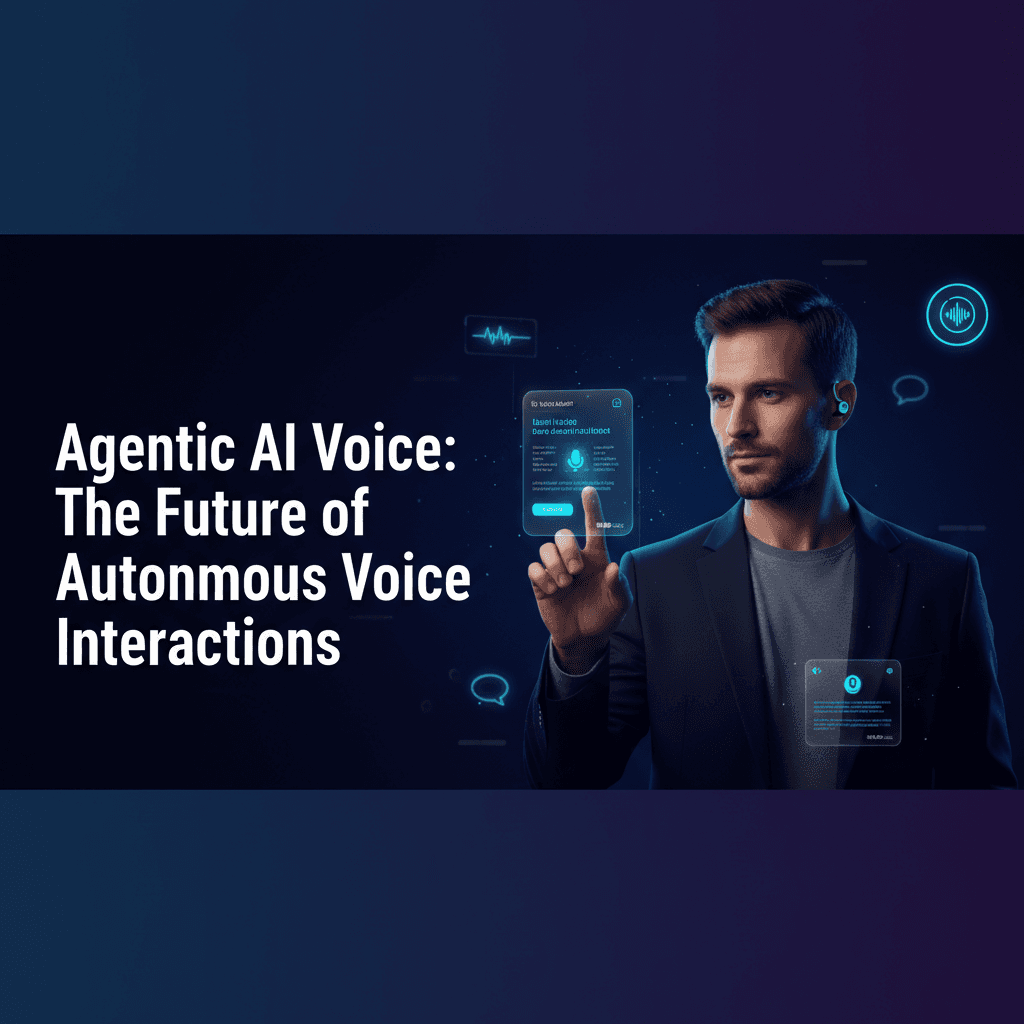
In the rapidly evolving landscape of artificial intelligence, a new frontier is emerging: agentic AI voice. Far beyond simple voice assistants, agentic AI voice represents a paradigm shift, enabling machines to not only understand human speech but also to reason, make decisions, and autonomously complete complex tasks. This advanced form of AI is poised to revolutionize how businesses interact with customers, streamline operations, and drive efficiency. For enterprises looking to gain a competitive edge, understanding and implementing agentic AI voice agents is no longer a luxury but a strategic imperative.
What is Agentic AI Voice?
At its core, agentic AI voice refers to an artificial intelligence system that can act as an independent agent. Unlike traditional voice AI, which primarily responds to direct commands or provides information, an agentic AI voice agent possesses a higher degree of autonomy. It can understand context, infer intent, plan multi-step actions, and execute tasks without constant human oversight. Think of it as an AI phone assistant that doesn't just follow a script but can adapt, learn, and even initiate actions to achieve a defined goal. These autonomous voice agents are equipped with reasoning capabilities, allowing them to handle dynamic and unpredictable situations with greater sophistication.
Agentic vs. Traditional Voice AI: A Key Distinction
The distinction between agentic AI voice and conventional voice AI is crucial for understanding its transformative potential. Traditional voice AI, often seen in basic chatbots or IVR systems, is largely reactive and rule-based. It excels at answering FAQs or routing calls based on predefined pathways. While useful, its capabilities are limited to programmed responses.
Agentic voice for enterprise, on the other hand, is proactive and goal-oriented. It leverages advanced natural language understanding (NLU) and machine learning to interpret complex queries, understand nuances, and even anticipate needs. An AI calling agent powered by agentic principles can not only understand a customer's request but also access databases, process transactions, and follow up autonomously, mimicking the capabilities of a human agent more closely. This shift from mere interaction to independent action is what makes agentic AI voice agents so powerful.
Transforming Industries with Agentic AI Voice
The applications for agentic AI voice are vast and span across numerous sectors, offering significant ROI through enhanced efficiency and improved customer experiences.
Revolutionizing Customer Service and Call Centers
One of the most impactful areas for agentic AI voice is in customer service. Traditional call centers often struggle with high call volumes, long wait times, and agent burnout. Agentic voice customer service offers a compelling solution. An AI call answering agent can handle routine inquiries, process orders, schedule appointments, and even resolve complex issues by accessing and synthesizing information from various systems. This frees up human agents to focus on more intricate or sensitive customer interactions, significantly improving overall service quality and reducing operational costs. Call center automation AI is no longer just about routing calls; it's about intelligent, autonomous problem-solving.
Streamlining Workflow Automation with Voice AI
Beyond customer-facing roles, agentic AI voice agents are powerful tools for internal workflow automation. Imagine an AI voice workflow automation system that can process expense reports, update CRM records, or even manage supply chain logistics through natural language commands. Voice-first agentic AI can integrate seamlessly with existing enterprise systems, allowing employees to complete tasks more efficiently without needing to navigate complex interfaces. This level of enterprise voice automation reduces manual effort, minimizes errors, and accelerates business processes across departments.
Enhancing Sales and Marketing Efforts
Agentic AI voice can also play a pivotal role in sales and marketing. An AI calling agent can qualify leads, conduct preliminary sales calls, or even re-engage dormant customers with personalized outreach. By understanding customer responses and adapting its conversational strategy, a conversational AI agent can nurture leads more effectively, freeing up human sales teams to focus on closing deals. This proactive engagement can significantly boost conversion rates and customer retention.
The Benefits of Implementing Agentic Voice for Enterprise
Adopting agentic voice interfaces and AI voice agent services for businesses offers a multitude of advantages:
- Cost Reduction: Automating routine and complex tasks reduces the need for extensive human intervention, lowering operational expenses.
- 24/7 Availability: Autonomous voice agents can operate around the clock, providing uninterrupted service and support.
- Improved Customer Satisfaction: Faster resolution times, personalized interactions, and consistent service lead to happier customers.
- Scalability: AI systems can easily scale to handle fluctuating demand without the challenges of hiring and training human staff.
- Increased Efficiency: Automating workflows frees up human employees to focus on higher-value tasks, boosting overall productivity.
- Data-Driven Insights: Agentic AI can collect and analyze vast amounts of conversational data, providing valuable insights into customer behavior and operational bottlenecks.
The Future is Voice-First Agentic AI
As technology advances, the capabilities of agentic AI voice will only grow. We are moving towards a future where voice interactions with AI are indistinguishable from human conversations, and where AI agents can proactively manage complex business processes with minimal oversight. Businesses that embrace this technology now will be well-positioned to lead their respective markets, offering unparalleled efficiency and customer experiences. The era of the truly autonomous voice agent AI is here, and its potential is boundless.
Frequently Asked Questions About Agentic AI Voice
Q: What is the main difference between agentic AI voice and a standard chatbot?
A: A standard chatbot typically follows predefined rules and scripts, offering reactive responses. Agentic AI voice, on the other hand, is an autonomous voice agent that can understand context, reason, plan multi-step actions, and proactively complete tasks to achieve a specific goal, much like a human agent. It's about independent action and problem-solving, not just information retrieval.
Q: How can agentic AI voice benefit my call center?
A: For call centers, agentic AI voice agents can significantly reduce call volumes for human agents by handling routine inquiries, processing transactions, and resolving common issues autonomously. This leads to reduced wait times, 24/7 availability, improved customer satisfaction, and allows human agents to focus on more complex or empathetic interactions, boosting overall efficiency and reducing operational costs. It's a key component of advanced call center automation AI.
Q: Is agentic AI voice suitable for small businesses?
A: While often discussed in the context of large enterprises, agentic AI voice services for businesses of all sizes are becoming more accessible. Small businesses can leverage AI phone assistant capabilities to provide professional customer service, automate appointment scheduling, or manage basic inquiries, allowing them to compete with larger companies by offering scalable and efficient operations without significant overhead.
Q: What are some examples of tasks an agentic AI voice can perform?
A: An agentic AI voice can perform a wide range of tasks, including booking appointments, processing orders and returns, updating customer information, answering complex FAQs, troubleshooting technical issues, qualifying sales leads, conducting surveys, and even managing internal workflows like expense reporting or data entry. Its ability to integrate with various systems makes it highly versatile for enterprise voice automation.
Q: How does agentic AI voice improve customer experience?
A: Agentic AI voice improves customer experience by providing instant, 24/7 support, reducing wait times, and offering personalized interactions. Its ability to understand complex requests and resolve issues efficiently leads to higher satisfaction rates. Customers appreciate the convenience and speed of resolving their queries without needing to wait for a human agent or navigate cumbersome menus, making it a superior conversational AI agent.