



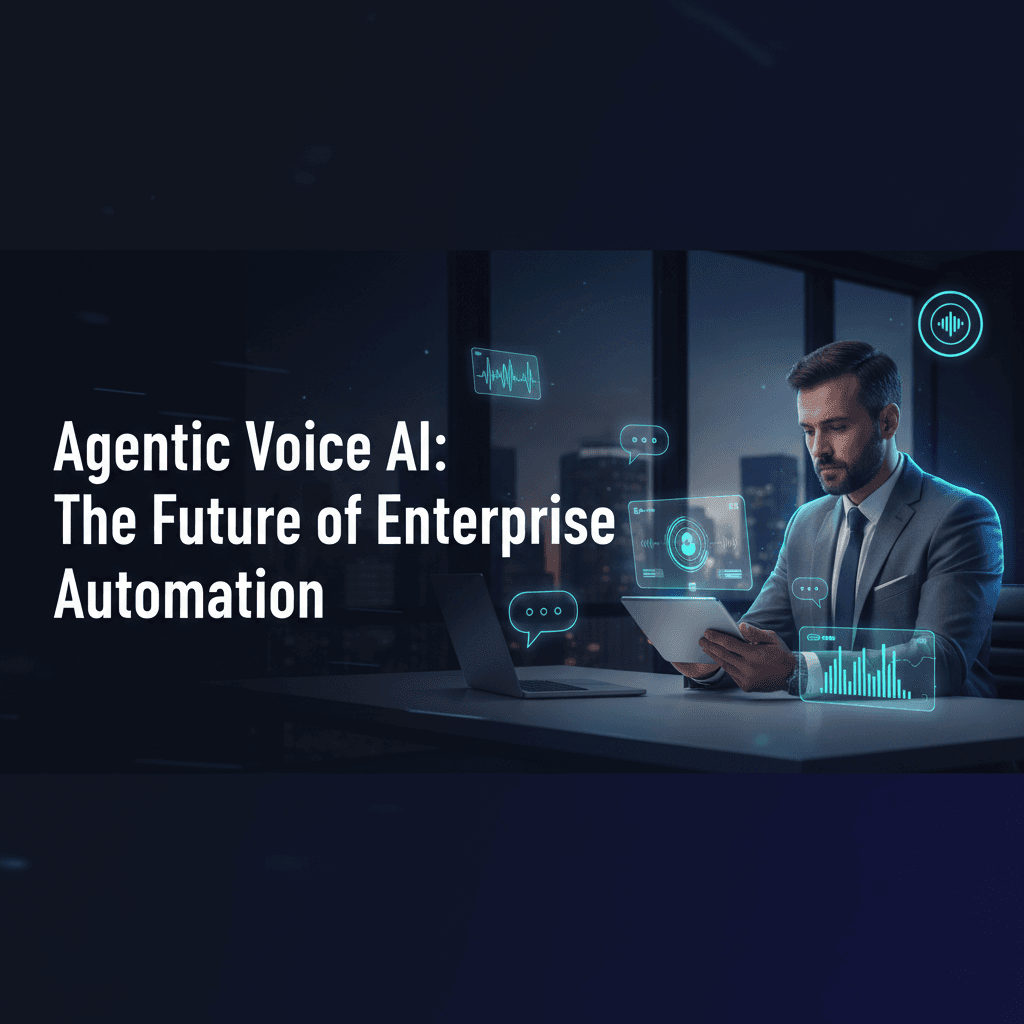
In the rapidly evolving landscape of artificial intelligence, a new paradigm is emerging that promises to redefine how businesses interact with their customers and manage complex operations: agentic voice AI. Far beyond traditional chatbots and simple voice assistants, agentic voice AI represents a significant leap forward, enabling systems to not just understand and respond, but to autonomously execute multi-step tasks and achieve specific goals. For enterprises looking to enhance efficiency, improve customer experience, and unlock new levels of automation, understanding what is agentic voice AI is no longer optional – it's essential.
What is Agentic Voice AI?
At its core, agentic voice AI refers to artificial intelligence systems that possess the ability to act autonomously to achieve a defined objective. Unlike reactive voice AI systems that simply respond to prompts, agentic voice AI can plan, execute, monitor, and adapt its actions to complete complex tasks without constant human intervention. These are not merely sophisticated voice interfaces; they are intelligent agents capable of reasoning, making decisions, and interacting with various tools and systems to fulfill user requests.
Think of it as the difference between asking a simple question and having a system proactively manage an entire process. An autonomous voice agent doesn't just provide information; it can take action based on that information, initiating workflows, updating records, or even resolving issues end-to-end. This level of autonomy is what sets agentic AI voice assistants apart and makes them particularly powerful for enterprise applications.
Agentic Voice AI vs. Traditional Voice AI Agents
The distinction between agentic voice AI vs voice AI agents is crucial for enterprises evaluating their automation strategies. Traditional voice AI agents, often found in IVR systems or basic chatbots, excel at routing calls, answering FAQs, or collecting simple information. They follow predefined scripts and decision trees, and their capabilities are largely limited to the scope of their programming.
Agentic voice AI, on the other hand, operates with a higher degree of intelligence and flexibility. Key differentiators include:
- Autonomy: Agentic systems can initiate actions and adapt to unforeseen circumstances.
- Goal-Oriented: They are designed to achieve specific outcomes, not just respond to inputs.
- Multi-step Workflow Automation: They can orchestrate and execute complex sequences of tasks across different systems.
- Tool Use: Advanced agentic systems are often voice agents with tool use, meaning they can integrate with and leverage enterprise applications (CRMs, ERPs, databases) to perform actions like scheduling appointments, processing orders, or updating customer profiles.
- Contextual Understanding: They maintain context across extended conversations and can reason about user intent even when expressed implicitly.
Key Agentic Voice AI Use Cases for Enterprise
The potential of agentic voice AI for enterprise spans numerous departments and functions, driving significant ROI and competitive advantage. Here are some prominent agentic voice AI use cases:
AI Voice Agent for Customer Service & Support
This is perhaps the most immediate and impactful application. Agentic AI customer service automation can transform call centers by handling a vast array of inquiries and tasks that previously required human agents. An AI voice agent for customer service can:
- Process returns and exchanges.
- Update account information.
- Resolve billing disputes.
- Schedule service appointments.
- Provide personalized product recommendations.
- Even proactively reach out to customers for follow-ups or issue resolution.
This leads to significant improvements in first-call resolution rates, reduced wait times, and a better overall customer experience. It also frees up human agents to focus on more complex, empathetic interactions.
Voice AI Call Center Automation
Beyond individual customer interactions, agentic voice AI can power comprehensive voice AI call center automation. This includes intelligent routing, proactive outbound calls for appointment reminders or overdue payments, and even post-call summarization and analysis. By automating repetitive tasks, businesses can scale their operations without proportionally increasing headcount, leading to substantial cost savings and improved operational efficiency.
Multistep Voice Workflow Automation
Many business processes involve multiple steps, systems, and approvals. Multistep voice workflow automation allows agentic voice AI to orchestrate these complex sequences. For example, an agent could handle an insurance claim from initial submission to payout, interacting with policy databases, payment systems, and even external adjusters, all through voice commands and autonomous actions. This capability is a game-changer for streamlining operations across various departments.
Voice AI for Enterprise Sales
In sales, agentic voice AI can act as a powerful assistant or even a frontline agent. Voice AI for enterprise sales can qualify leads, schedule demos, provide product information, process orders, and follow up with prospects. Imagine an AI voice agent that can conduct initial discovery calls, identify customer needs, and then seamlessly hand off a highly qualified lead to a human salesperson, complete with a detailed summary of the conversation.
Enterprise Conversational AI with RAG Voice Agents
For enterprises, accuracy and up-to-date information are paramount. This is where RAG voice agents (Retrieval Augmented Generation) come into play. RAG combines the generative power of large language models with the ability to retrieve information from a company's proprietary knowledge bases, documents, and databases. This ensures that the agentic voice AI provides accurate, consistent, and contextually relevant responses based on the most current internal data, rather than relying solely on its pre-trained knowledge.
Integrating RAG capabilities into enterprise conversational AI systems means that the voice agents can access specific product catalogs, policy documents, customer histories, and internal guidelines in real-time, delivering highly informed and precise interactions.
Critical Considerations for Enterprise Deployment
Implementing agentic voice AI for enterprise requires careful consideration of several factors to ensure successful and compliant deployment:
- Security and Compliance: Adherence to industry regulations (e.g., HIPAA, GDPR, PCI DSS) is non-negotiable. Voice AI systems must incorporate robust security measures, data encryption, and audit trails.
- Data Residency: For global enterprises, ensuring voice AI compliance and data residency requirements are met is critical. Data must be stored and processed in specific geographical locations as mandated by local laws.
- Integration Capabilities: Seamless integration with existing CRM, ERP, and other enterprise systems is essential for the agentic AI to perform its multi-step workflows effectively.
- Scalability and Reliability: The solution must be able to handle fluctuating call volumes and maintain high availability.
- Customization and Training: The ability to train the AI with industry-specific terminology, company policies, and brand voice is key to delivering a consistent and effective experience.
- Monitoring and Analytics: Tools for monitoring agent performance, identifying areas for improvement, and analyzing customer interactions are vital for continuous optimization.
- Role-Based Access Control (RBAC) & Single Sign-On (SSO): For internal use cases, ensuring secure access and identity management is crucial.
- Service Level Agreements (SLAs): Enterprises need clear SLAs from their AI providers to guarantee performance and support.
The Future is Autonomous
Agentic voice AI is not just a technological advancement; it's a strategic imperative for businesses aiming to stay competitive in an increasingly automated world. By empowering autonomous voice agents to handle complex, multi-step tasks, enterprises can achieve unprecedented levels of efficiency, deliver superior customer experiences, and free their human workforce to focus on high-value activities that require empathy, creativity, and strategic thinking. The journey towards fully autonomous, intelligent voice interactions has begun, and businesses that embrace agentic voice AI will be at the forefront of this transformation.
Frequently Asked Questions (FAQ)
Q: How does agentic voice AI improve customer satisfaction?
Agentic voice AI improves customer satisfaction by providing instant, 24/7 assistance, reducing wait times, and resolving complex issues autonomously. Its ability to access and act upon real-time data ensures personalized and accurate interactions, leading to quicker resolutions and a more positive customer experience.
Q: Is agentic voice AI difficult to integrate with existing enterprise systems?
While integration requires careful planning, modern agentic voice AI platforms are designed with robust APIs and connectors to facilitate seamless integration with common enterprise systems like CRMs (e.g., Salesforce), ERPs (e.g., SAP), and internal databases. The complexity often depends on the age and architecture of the existing systems, but the benefits of multistep voice workflow automation typically outweigh the integration effort.
Q: What are the main security concerns with agentic voice AI, especially for sensitive data?
Security is a top priority. Key concerns include data privacy, unauthorized access, and compliance with regulations like GDPR and HIPAA. Enterprises should look for solutions that offer end-to-end encryption, strict access controls (like RBAC), robust authentication, and audit logging. Providers should also clearly outline their policies on voice AI compliance and data residency, ensuring data is handled and stored according to legal requirements.
Q: How does agentic voice AI handle situations it hasn't been explicitly trained for?
Advanced agentic voice AI systems leverage large language models (LLMs) and techniques like Retrieval Augmented Generation (RAG). This allows them to generalize beyond their explicit training data by reasoning and retrieving relevant information from a vast knowledge base. If an agent encounters a completely novel or ambiguous situation, it can be programmed to escalate to a human agent seamlessly, providing all collected context for efficient resolution. Continuous learning and human feedback also help improve its capabilities over time.