



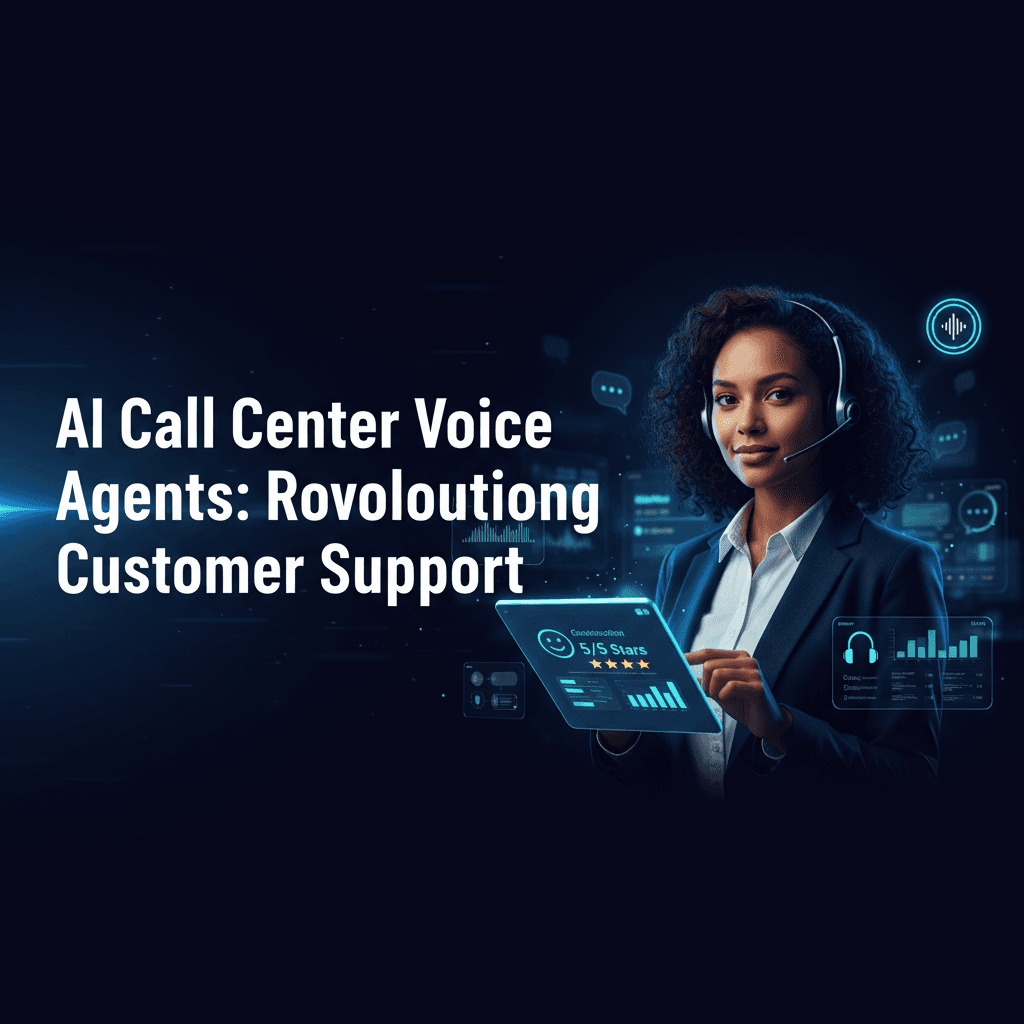
In today's fast-paced digital landscape, customer expectations are higher than ever. Businesses are constantly seeking innovative solutions to deliver exceptional service while optimizing operational efficiency. Enter the AI call center voice agent – a groundbreaking technology that is redefining how companies interact with their customers. These intelligent virtual assistants, powered by advanced artificial intelligence, are capable of understanding, processing, and responding to human speech, effectively automating a significant portion of call center operations. From handling routine inquiries to providing personalized support, AI voice agents for call centers are becoming an indispensable tool for modern enterprises.
What is an AI Call Center Voice Agent?
An AI call center voice agent is an intelligent software program designed to interact with customers via voice, mimicking human conversation. Utilizing natural language processing (NLP), machine learning (ML), and speech recognition technologies, these agents can understand customer queries, retrieve relevant information, and provide accurate, context-aware responses. This technology goes far beyond traditional IVR systems, offering a truly conversational experience. They are the backbone of AI contact center voice automation, enabling businesses to scale their support operations without proportionally increasing human agent headcount.
How AI Voice Agents Transform Call Center Operations
Inbound AI Voice Agent for Customer Support
For inbound calls, AI voice agents excel at handling common customer service requests. They can answer FAQs, provide account information, process simple transactions, and troubleshoot basic issues. This frees up human agents to focus on more complex or sensitive cases, leading to improved efficiency and job satisfaction. The ability to offer 24/7 AI phone support agent services ensures that customers can get assistance anytime, anywhere, significantly boosting customer satisfaction.
Outbound AI Voice Agent for Sales and Follow-up
Beyond inbound support, AI voice agents are also highly effective for outbound communications. They can conduct proactive customer outreach for surveys, appointment reminders, debt collection, and even lead qualification. An outbound AI voice agent for sales and follow-up can significantly enhance sales pipelines by pre-qualifying leads or following up on abandoned carts, ensuring no opportunity is missed.
AI Call Routing and Intelligent Call Deflection
One of the most immediate benefits of conversational AI for call centers is its ability to improve call routing. AI can accurately understand the customer's intent and direct them to the most appropriate resource, whether that's a human agent specializing in a particular area or an automated self-service option. This intelligent call deflection reduces transfer rates and improves first-call resolution.
Key Benefits of AI Call Center Voice Agents
The adoption of call center automation with AI voice agents brings a multitude of advantages:
- Significant Cost Reduction: Automating routine tasks with AI voice agents directly contributes to AI call center cost reduction by lowering staffing needs and operational overhead.
- Enhanced Customer Experience: Offering instant, 24/7 support and personalized interactions leads to higher customer satisfaction and loyalty. Customers appreciate quick resolutions and the ability to get help outside of traditional business hours.
- Improved Efficiency and Productivity: Human agents can focus on complex issues, while AI handles repetitive queries, leading to overall higher productivity for the entire team.
- Scalability: AI voice agents can handle an unlimited volume of calls simultaneously, making it easy to scale operations up or down based on demand without significant infrastructure changes.
- Multilingual Support: A multilingual AI voice agent for support can instantly serve customers in various languages, expanding market reach and improving global customer service.
- Data Collection and Insights: Every interaction handled by an AI voice agent generates valuable data, providing insights into customer behavior, common issues, and areas for improvement.
Seamless Integration: AI Call Center CRM Integration
For maximum effectiveness, AI call center CRM integration is crucial. When AI voice agents are connected to a company's CRM system, they can access customer history, preferences, and previous interactions. This allows them to provide highly personalized and informed responses, creating a seamless and consistent customer journey. For example, an AI appointment booking voice agent can not only schedule appointments but also access customer records to suggest optimal times based on past interactions or service agreements.
AI Voice Agent Use Cases Across Industries
The versatility of AI voice bots for customer service makes them applicable across a wide range of sectors:
- Healthcare: AI voice agent use cases in healthcare include appointment scheduling, prescription refills, answering FAQs about services, and providing information on clinic hours.
- Telecommunications: AI voice agent use cases in telecom involve bill inquiries, technical support for common issues, plan upgrades, and service activation.
- Retail & E-commerce: Order status updates, product information, return processing, and personalized recommendations.
- Banking & Finance: Balance inquiries, transaction history, fraud alerts, and loan application status updates.
- Travel & Hospitality: Booking assistance, flight status updates, hotel reservations, and answering questions about amenities.
Challenges and Considerations for Implementation
While the benefits are clear, successful implementation requires careful planning:
- Defining Scope: Clearly identify which tasks AI voice agents will handle and which will remain with human agents.
- Data Quality: The effectiveness of AI heavily relies on the quality and quantity of training data.
- Integration Complexity: Ensuring seamless integration with existing CRM, ERP, and other business systems.
- Human Handoff: Establishing clear protocols for when and how an AI agent should transfer a call to a human agent, ensuring a smooth transition.
- Continuous Improvement: AI models need ongoing monitoring and training to adapt to new queries and improve performance over time.
The Future is Conversational
The evolution of AI voice agents for call centers marks a significant leap forward in customer service. By embracing these intelligent tools, businesses can not only meet but exceed customer expectations, drive efficiency, and unlock new levels of operational excellence. The future of customer support is undoubtedly conversational, powered by the sophisticated capabilities of AI.
Frequently Asked Questions About AI Call Center Voice Agents
Q: How do AI voice agents differ from traditional IVR systems?
Traditional IVR (Interactive Voice Response) systems rely on pre-recorded menus and rigid, keyword-based responses. AI voice agents, in contrast, use natural language processing (NLP) to understand complex, free-form human speech and provide dynamic, context-aware responses, offering a much more natural and conversational experience.
Q: Can AI voice agents handle complex customer issues?
While AI voice agents excel at handling routine and repetitive tasks, their ability to handle complex issues is constantly improving. For truly complex or emotionally charged situations, they are typically programmed to seamlessly transfer the customer to a human agent, providing all the gathered context for a smooth handoff. This is a key aspect of effective AI call routing and intelligent call deflection.
Q: What is the impact of AI voice agents on job security for human call center agents?
Rather than replacing human agents, AI voice agents often augment their capabilities. By automating mundane tasks, AI allows human agents to focus on more challenging, rewarding, and high-value interactions that require empathy, critical thinking, and problem-solving skills. This can lead to increased job satisfaction and a more strategic role for human agents within the call center.
Q: How long does it take to implement an AI call center voice agent?
Implementation timelines vary greatly depending on the complexity of the desired functionalities, the level of integration with existing systems (like AI call center CRM integration), and the amount of training data available. Simple deployments might take a few weeks, while more sophisticated, enterprise-wide solutions could take several months. A phased approach is often recommended to allow for iterative improvements.