

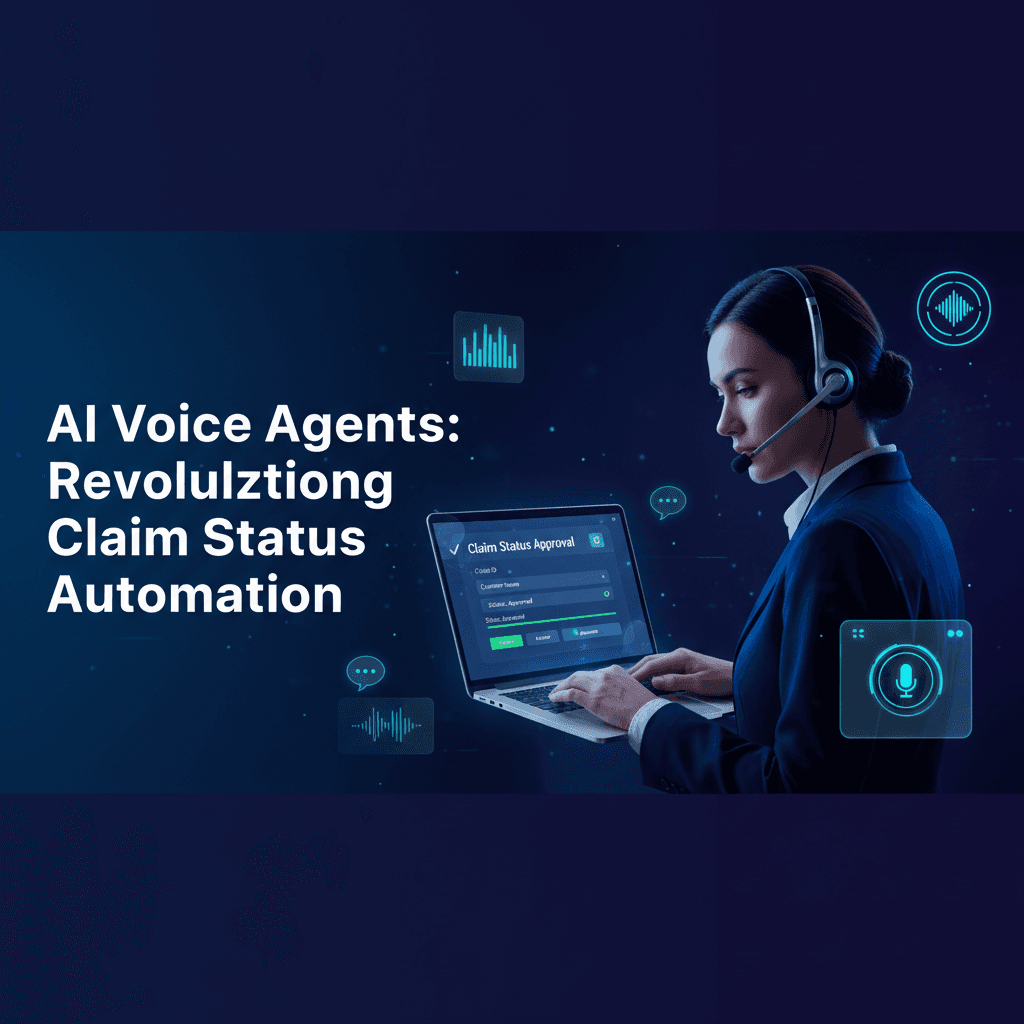
In today's fast-paced healthcare and insurance industries, managing a high volume of claim status inquiries can be a significant drain on resources. Policyholders and providers frequently call to check on the status of claims, leading to long wait times, frustrated callers, and increased operational costs. This is where the power of an AI voice agent for claim status automation comes into play, offering a transformative solution to streamline these interactions and improve overall efficiency.
By leveraging advanced conversational AI, organizations can automate claim status calls with AI voice, significantly reducing the burden on human agents while providing instant, accurate information to callers. This article will delve into the multifaceted benefits of implementing an AI voice agent for insurance claims status and healthcare claim status, exploring its capabilities, key considerations for technical buyers, and how it can revolutionize your claims management process.
The Challenge: High Volume Claim Status Inquiries
Customer service centers in both healthcare and insurance are often overwhelmed by repetitive inquiries. A significant portion of these calls revolves around checking the status of a claim. These calls, while essential for policyholders and providers, are often straightforward and don't require complex problem-solving. However, they consume valuable agent time, leading to:
- Increased operational costs due to staffing requirements.
- Longer hold times and reduced customer satisfaction.
- Agent burnout from repetitive tasks.
- Inconsistent information delivery.
The need for an efficient and scalable solution is paramount, and this is precisely where voice AI for claim status verification shines.
How AI Voice Agents Automate Claim Status Calls
An AI voice agent for eligibility and claims status utilizes natural language processing (NLP) and speech recognition to understand and respond to caller queries. When a caller dials in, the AI agent can:
- Identify the caller: Through secure authentication methods (e.g., policy number, date of birth, or even voice biometrics).
- Understand the intent: Accurately discern that the caller is asking for a claim status update.
- Access relevant data: Integrate with existing claims management systems, RCM platforms, or payer portals to retrieve real-time claim information.
- Provide accurate responses: Deliver clear, concise, and personalized claim status updates, including details like submission date, current stage, and expected resolution.
- Handle complex scenarios: For more intricate issues, seamlessly transfer the call to a human agent with all collected information, ensuring a smooth transition.
This capability extends to various scenarios, including ai voice agent for healthcare claim status, ai voice agent for insurance claims status, and even specialized areas like ai voice agent for tpa claim status and ai voice agent for third party administrator claims.
Key Benefits for Healthcare and Insurance Providers
Reduced Operational Costs
By automating a significant portion of routine inquiries, organizations can drastically reduce claim status call volume. This means fewer human agents are needed for these tasks, leading to substantial savings in labor costs and allowing existing staff to focus on more complex, high-value interactions. This is a primary driver for adopting automated claim status phone calls AI solutions.
Improved Policyholder and Provider Experience
Callers no longer have to endure long hold times or navigate complex IVR menus. An AI voice agent for claim status automation provides instant, 24/7 access to information, leading to higher satisfaction rates. The ability to get immediate answers, even for ai voice agent for billing claim status, significantly enhances the overall experience.
Enhanced Accuracy and Consistency
AI agents retrieve information directly from integrated systems, eliminating human error and ensuring that every caller receives consistent and accurate updates. This is crucial for maintaining trust and compliance.
Scalability and Efficiency
AI voice agents can handle an unlimited number of concurrent calls, scaling effortlessly to meet demand fluctuations without the need for additional staffing. This makes them ideal for managing peak call volumes and ensuring continuous service availability. This efficiency is a hallmark of conversational AI for claim status automation.
Considerations for Technical Buyers: Choosing the Best AI Voice Agent
When evaluating best AI voice agents for claim status calls, technical buyers must consider several critical factors to ensure a successful implementation:
HIPAA and BAA Readiness
For healthcare providers, compliance with HIPAA (Health Insurance Portability and Accountability Act) is non-negotiable. The AI voice agent must be designed with robust security protocols and privacy measures to protect Protected Health Information (PHI). A Business Associate Agreement (BAA) with the vendor is essential to ensure compliance.
IVR Navigation Capabilities
Many claim status inquiries involve navigating complex payer IVRs. An effective ai voice agent for payer claim status navigation should possess advanced capabilities to interact with and extract information from these systems, minimizing manual intervention and accelerating the process. This is particularly relevant for voice AI for insurance claim updates.
Integration with Existing Systems
Seamless integration with Revenue Cycle Management (RCM) systems, Electronic Health Records (EHR), claims management platforms, and CRM systems is crucial. The AI agent needs to access real-time data to provide accurate and up-to-date information. Look for solutions with open APIs and proven integration capabilities.
Natural Language Understanding (NLU) and Speech Recognition
The effectiveness of an AI voice agent hinges on its ability to accurately understand diverse accents, speech patterns, and industry-specific terminology. Robust NLU and speech recognition are vital for a smooth and frustration-free caller experience. This is especially important for applications like ai voice agent for FNOL and claim status, where initial reports can be varied.
Scalability and Customization
The solution should be able to scale with your organization's growth and be customizable to your specific workflows, business rules, and branding. The ability to easily update scripts and responses is also a key factor.
Conclusion
The implementation of an AI voice agent for claim status automation is no longer a luxury but a necessity for healthcare and insurance organizations looking to optimize operations, reduce costs, and significantly improve the customer experience. By carefully evaluating solutions based on compliance, integration capabilities, and advanced AI features, technical buyers can select the right partner to transform their claims management process. Embracing voice AI to reduce claim status call volume is a strategic move that yields substantial returns, positioning your organization for future success in a competitive landscape.
Frequently Asked Questions (FAQ)
What is an AI voice agent for claim status automation?
An AI voice agent for claim status automation is an intelligent virtual assistant that uses artificial intelligence, natural language processing, and speech recognition to handle inbound phone calls related to claim status inquiries. It can understand caller requests, retrieve real-time information from integrated systems, and provide accurate, automated responses, effectively automating claim status calls with AI voice.
Is an AI voice agent for healthcare claim status HIPAA compliant?
Yes, reputable AI voice agents designed for healthcare claim status must be HIPAA compliant. This involves robust data encryption, secure data handling protocols, and the ability to sign a Business Associate Agreement (BAA) with the healthcare provider. Always verify the vendor's compliance certifications.
How does voice AI reduce claim status call volume?
Voice AI reduces call volume by automating routine inquiries that would typically go to human agents. By providing instant, accurate, and self-service options for claim status verification, it deflects a significant percentage of calls, allowing human agents to focus on more complex issues and reducing overall call center traffic.
Can an AI voice agent navigate payer IVRs for claim status?
Absolutely. Advanced AI voice agents are equipped with capabilities to navigate complex payer IVRs. They can dial into payer systems, listen to prompts, input necessary information (like claim numbers or patient IDs), and extract the required claim status details, making them an effective ai voice agent for payer claim status navigation.
What systems does an AI voice agent for insurance claims status integrate with?
A robust AI voice agent for insurance claims status typically integrates with a wide range of systems, including claims management platforms, CRM systems, RCM (Revenue Cycle Management) software, EHR/EMR systems, and various third-party payer portals. This ensures access to comprehensive, real-time data for accurate claim status updates.