



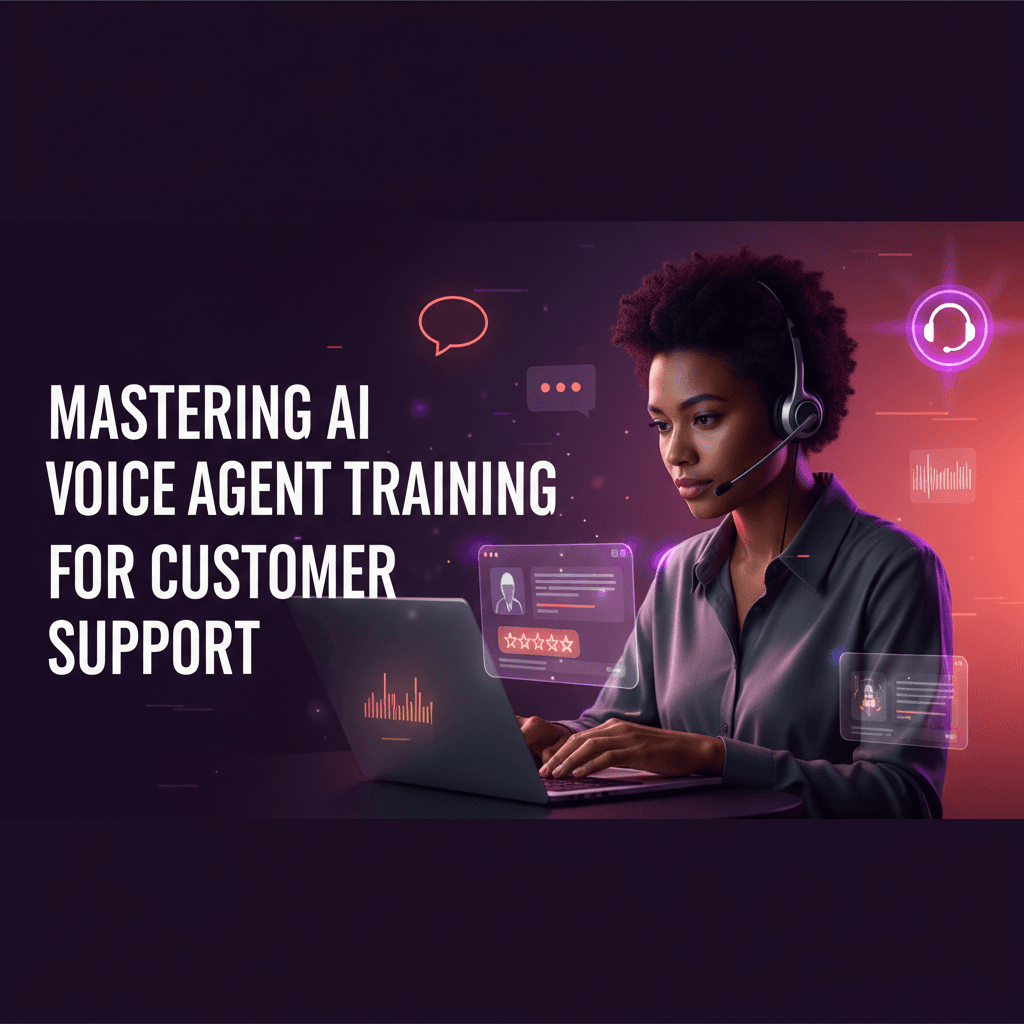
In today's fast-paced customer service landscape, the demand for efficient and effective support is higher than ever. Artificial intelligence (AI) voice agents are emerging as a powerful solution, but their success hinges on robust and strategic ai voice agent training for customer support. This guide delves into the essential strategies and best practices to transform your AI voice agents into invaluable assets for your support teams, ensuring they deliver exceptional customer experiences.
Why AI Voice Agent Training is Crucial for Customer Support
The effectiveness of an AI voice agent directly correlates with the quality of its training. Without proper instruction, an AI agent can fall short, leading to frustrated customers and inefficiencies. Effective ai voice agent training for customer support ensures your agents can understand complex queries, provide accurate information, and even exhibit empathy. It’s not just about automation; it’s about enhancing the customer journey and empowering your human agents to focus on more complex, high-value interactions. Understanding how to train ai voice agents for customer service is paramount for any organization looking to scale its support operations effectively.
Key Pillars of Effective AI Voice Agent Training
1. Leveraging Real Customer Call Data for Training
One of the most impactful strategies for ai voice agent training for customer support is to utilize actual customer interactions. Training AI voice agents with real customer call data provides an authentic understanding of customer language, common issues, and emotional nuances. This data-driven approach helps the AI agent learn to recognize various accents, speech patterns, and even sentiment, leading to significantly improved comprehension and response accuracy. Anonymized and transcribed call data becomes a goldmine for refining the AI's natural language understanding (NLU) and natural language generation (NLG) capabilities.
2. Realistic Simulations and Roleplays
Just as human agents benefit from role-playing, AI voice agents thrive on simulated scenarios. Implementing realistic AI voice simulations for customer support training allows AI agents to practice handling a wide array of customer queries, complaints, and requests in a controlled environment. This includes customer support training with AI voice roleplays, where the AI can interact with human trainers playing the role of customers, providing immediate feedback and allowing for iterative improvements. This method is crucial for refining the AI's conversational flow and problem-solving abilities before live deployment.
3. Persona and Tone Training
A successful AI voice agent isn't just about accuracy; it's also about how it makes the customer feel. AI voice agent persona training for support scenarios focuses on developing a consistent and appropriate brand voice. This involves ai voice agent tone and personality training for support, ensuring the AI communicates with empathy, professionalism, and a helpful demeanor. For instance, an AI agent for a luxury brand might have a more sophisticated tone compared to one for a tech support line. Defining and training for these nuances is a critical aspect of ai voice agent training best practices for support teams.
4. Leveraging LLMs for Enhanced Training
Large Language Models (LLMs) are revolutionizing AI capabilities. Incorporating LLM-powered voice agents for customer support training can significantly boost the AI's ability to understand context, generate natural responses, and even learn from fewer examples. LLMs can help in creating more dynamic and human-like conversations, making the AI agent more adaptable to unforeseen customer queries and complex dialogue flows. This advanced training method accelerates the learning curve and improves the overall intelligence of the AI.
5. Continuous Improvement and Testing
AI voice agent training is not a one-time event. It requires continuous retraining of AI voice agents for support. Regular ai voice agent testing for customer support scenarios is vital to identify areas for improvement. This includes A/B testing, user acceptance testing, and monitoring live interactions. The goal is to be constantly improving AI voice agent accuracy for customer support, adapting to new products, services, and customer feedback. Metrics like resolution rates, customer satisfaction scores, and containment rates are essential for this ongoing optimization.
6. Fallback and Escalation Training
Even the most advanced AI agents will encounter situations they can't resolve. Proper ai voice agent fallback and escalation training for support is crucial. This involves teaching the AI when and how to seamlessly transfer a customer to a human agent, providing all relevant context to ensure a smooth transition. The AI should be trained to recognize its limitations and understand the appropriate escalation paths, preventing customer frustration and ensuring complex issues are handled effectively.
Measuring Success: AI Voice Agent Metrics
To truly understand the impact of your ai voice agent training for customer support, you need to track key performance indicators. AI voice agent metrics for customer support performance include: resolution rate, customer satisfaction (CSAT) scores, average handling time (AHT), containment rate (percentage of interactions handled entirely by the AI), and first contact resolution (FCR). Regularly analyzing these metrics allows you to identify areas where your AI agents excel and where further training or adjustments are needed, ensuring you are continually building AI voice agents for customer support automation that deliver tangible value.
Simplifying Training: No-Code Solutions
The good news is that ai voice agent training for customer support doesn't always require deep technical expertise. Many platforms now offer no-code AI voice agent training for customer support, allowing support managers and trainers to configure and optimize AI agents using intuitive interfaces. These tools democratize AI, making it accessible for teams to build, train, and deploy sophisticated voice agents without extensive coding knowledge, accelerating the path to automated customer support.
Conclusion
Effective ai voice agent training for customer support is the cornerstone of successful AI-driven customer service. By focusing on real data, realistic simulations, persona development, continuous improvement, and robust fallback mechanisms, organizations can deploy AI voice agents that not only automate tasks but also enhance the overall customer experience. Embracing these ai voice agent training best practices for support teams will empower your business to deliver superior, scalable, and empathetic customer support in the digital age.
Frequently Asked Questions (FAQ)
Q: How long does it take to train an AI voice agent for customer support?
A: The initial training phase can range from a few weeks to several months, depending on the complexity of the tasks, the volume of training data, and the desired level of sophistication. However, continuous retraining of AI voice agents for support is an ongoing process to maintain and improve performance.
Q: Can AI voice agents truly understand customer emotions?
A: While AI agents don't 'feel' emotions, advanced ai voice agent training for customer support, especially with real customer call data and LLMs, enables them to detect emotional cues in speech (tone, pitch, pace) and respond appropriately. This is part of ai voice agent tone and personality training for support, aiming for empathetic interactions.
Q: What kind of data is best for training AI voice agents?
A: The most effective data for ai voice agent training for customer support includes transcribed and anonymized recordings of actual customer service calls, chat logs, FAQs, knowledge base articles, and product documentation. This diverse dataset helps in training AI voice agents with real customer call data for comprehensive understanding.
Q: Is it possible to train AI voice agents without coding knowledge?
A: Yes, absolutely! Many modern platforms offer no-code AI voice agent training for customer support. These user-friendly interfaces allow support managers and trainers to configure, test, and deploy AI agents using drag-and-drop tools and intuitive workflows, making AI accessible to a broader audience.