



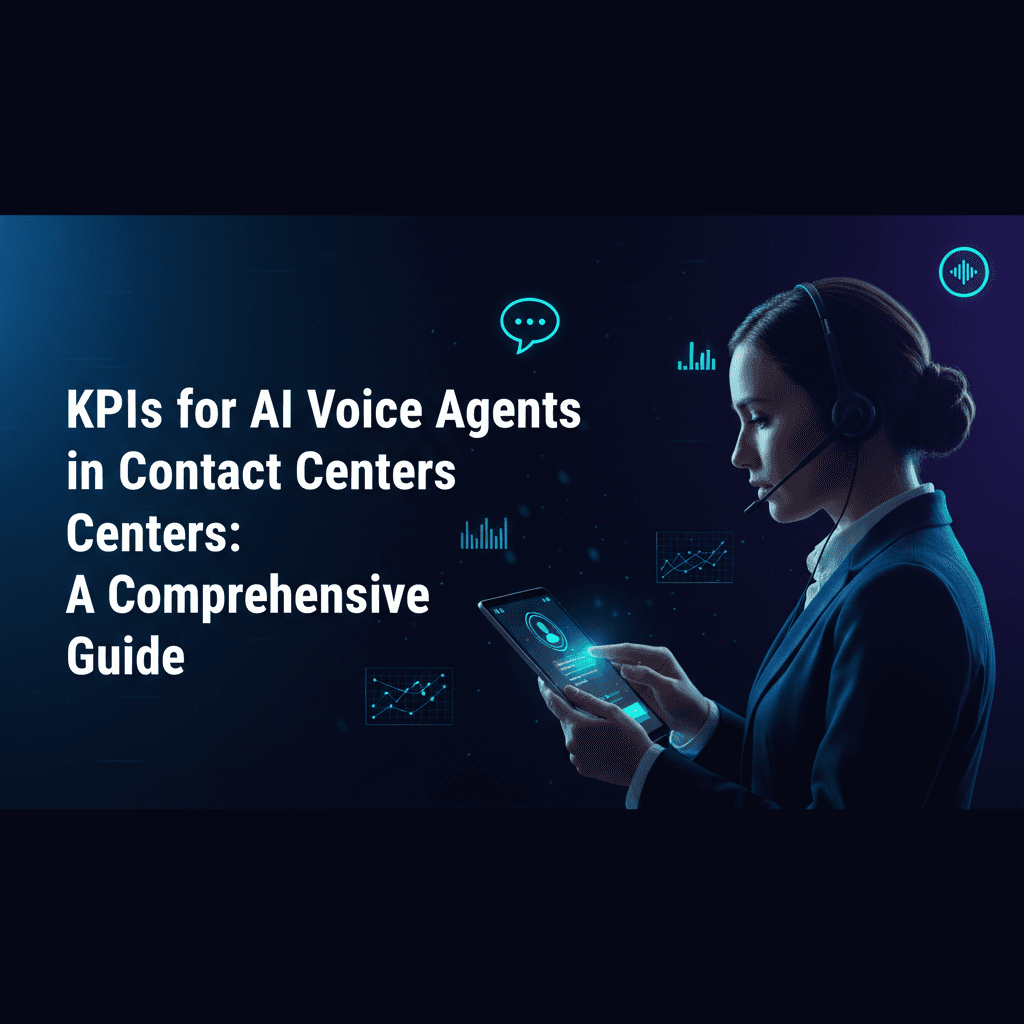
The integration of AI voice agents into contact centers is revolutionizing customer service, offering unparalleled efficiency and scalability. However, to truly harness their power and ensure they deliver on their promise, it's crucial to establish robust KPIs for AI voice agents in contact centers. Without clear metrics, it's impossible to gauge performance, identify areas for improvement, and ultimately, prove the return on investment (ROI). This comprehensive guide will delve into the most critical key performance indicators for AI voice bots in call centers, helping you effectively measure success and optimize your AI-powered customer interactions.
Why Measuring AI Voice Agent Performance is Crucial
Deploying AI voice agents isn't a set-it-and-forget-it endeavor. To ensure they are truly enhancing the customer experience and contributing to business goals, continuous monitoring and optimization are essential. By tracking the right metrics to measure AI voice agent success in contact centers, businesses can:
- Identify bottlenecks and areas where the AI needs further training.
- Demonstrate the value and ROI of AI investments.
- Improve customer satisfaction and loyalty.
- Optimize operational efficiency and reduce costs.
- Drive continuous improvement in AI capabilities and customer interactions.
Understanding these metrics is vital for any organization looking to leverage AI effectively in their customer service strategy.
Core KPIs for AI Voice Agent Efficiency and Resolution
Containment Rate and First Contact Resolution (FCR)
These are perhaps two of the most critical ai voice agent kpis for contact centers. The ai voice agent containment rate measures the percentage of interactions fully resolved by the AI without needing to escalate to a human agent. A high containment rate indicates efficient self-service. Similarly, First Contact Resolution (FCR), when applied to AI, tracks the percentage of customer issues resolved during the initial interaction with the AI voice agent. Both metrics are key indicators of the AI's ability to handle customer queries autonomously and effectively. Establishing clear ai voice agent containment rate and fcr benchmarks is crucial for setting performance targets.
Average Handle Time (AHT) Reduction
While AHT is traditionally a human agent metric, it's highly relevant for AI. Average Handle Time (AHT) reduction with AI voice agents measures how quickly the AI can resolve an interaction compared to previous methods or human agent averages. Shorter AHTs signify greater efficiency and can lead to significant cost savings. This is a vital part of measuring the overall operational impact of your AI voice solution.
Task Completion and Resolution Accuracy
Beyond just containment, it's essential to track ai voice agent task completion and resolution accuracy kpis. This involves measuring whether the AI successfully completes the requested task (e.g., changing an address, checking an order status) and if the information provided or action taken was correct. High accuracy rates build customer trust and prevent repeat contacts.
AI Voice Agent Escalation Rate and Handoff Metrics
Even with high containment, some interactions will require human intervention. Tracking the ai voice agent escalation rate and handoff metrics provides insight into when and why the AI needs to transfer a call. This can highlight complex issues the AI isn't yet equipped to handle or areas where the handoff process itself needs refinement for a smoother customer experience.
Customer Experience and Satisfaction KPIs
Customer Satisfaction (CSAT) and Net Promoter Score (NPS)
Ultimately, the goal of any contact center is to satisfy customers. The customer satisfaction csat kpi for ai voice support directly measures how happy customers are with their interactions with the AI. This can be gathered through post-interaction surveys. Similarly, NPS gauges customer loyalty and their willingness to recommend your service. These metrics are crucial for understanding the qualitative impact of your AI voice agents.
Repeat Contact Rate
A high repeat contact rate kpi for ai voice automation indicates that customers are not getting their issues fully resolved on the first attempt, even if the AI contained the initial interaction. This could point to a lack of clarity in the AI's responses or an inability to address the root cause of the customer's query. Reducing repeat contacts is a strong indicator of effective AI performance.
AI-Specific Performance Metrics
Intent Recognition Accuracy
One of the foundational capabilities of an AI voice agent is its ability to understand what the customer wants. The intent recognition accuracy kpi for ai voice agents measures how often the AI correctly identifies the customer's underlying intent. Low accuracy here will lead to frustration and poor outcomes. This is closely related to ai voice agent semantic accuracy and intent kpis, which delve deeper into the AI's understanding of natural language.
AI Voice Agent Cost Per Resolved Interaction
To truly understand the financial impact, tracking the ai voice agent cost per resolved interaction kpi is essential. This metric helps calculate the direct cost savings achieved by using AI compared to human agents. It's a key component when you're measuring ai voice agent roi in contact center operations.
Best KPIs for AI Outbound Calling in Contact Centers
For AI voice agents engaged in outbound campaigns, a different set of metrics comes into play. Key among these are:
- Connection Rate: Percentage of calls where the AI successfully connects with a live person.
- Conversion Rate: Percentage of calls where the AI achieves the desired outcome (e.g., appointment booked, survey completed, payment processed).
- Opt-out Rate: Number of customers who request not to be contacted again by the AI.
- Compliance Adherence: Ensuring the AI adheres to all regulatory requirements during outbound calls.
These are crucial for optimizing your best kpis for ai outbound calling in contact centers strategies.
Agentic AI CX KPIs for Contact Center Performance
As AI evolves towards more 'agentic' capabilities – meaning AI that can proactively understand context, anticipate needs, and execute multi-step processes – the KPIs also need to adapt. Agentic ai cx kpis for contact center performance will focus more on:
- Proactive Resolution Rate: How often the AI resolves an issue before the customer even explicitly states it.
- Contextual Understanding Score: A metric for the AI's ability to retain and apply context across multiple turns or interactions.
- Personalization Effectiveness: How well the AI tailors its responses and actions based on individual customer history and preferences.
- Complex Task Orchestration: The AI's success rate in managing and completing multi-stage, interdependent tasks.
These advanced metrics will become increasingly important as AI voice agents become more sophisticated.
Conclusion: Optimizing Your AI Voice Agent Strategy
Implementing AI voice agents in your contact center is a strategic move that can yield significant benefits. However, the true value is unlocked through meticulous measurement and continuous improvement. By diligently tracking these kpis for ai voice agents in contact centers, you can ensure your AI investments are paying off, delivering superior customer experiences, and driving operational excellence. Regularly review your ai voice agent kpis for contact centers, adjust your AI's training, and refine your strategies to stay ahead in the evolving landscape of customer service.
Frequently Asked Questions (FAQs)
What are the most important KPIs for AI voice agents?
The most important KPIs typically include Containment Rate, First Contact Resolution (FCR), Customer Satisfaction (CSAT), Intent Recognition Accuracy, and Average Handle Time (AHT) Reduction. These metrics provide a holistic view of both efficiency and customer experience.
How do you measure the ROI of AI voice agents?
Measuring ROI involves comparing the cost savings (e.g., reduced human agent hours, lower operational costs due to AHT reduction) and revenue gains (e.g., increased sales from outbound campaigns, improved customer retention from higher CSAT) against the investment in your AI voice solution. The ai voice agent cost per resolved interaction kpi is a direct input for this calculation.
What is the difference between containment rate and FCR for AI?
Containment rate specifically measures the percentage of interactions that are fully handled by the AI without escalating to a human agent. FCR, on the other hand, measures the percentage of customer issues that are resolved during the very first interaction, regardless of whether it's with AI or a human. For AI, a high containment rate often leads to a high FCR, but FCR ensures the issue is truly resolved, not just handled.
How can I improve my AI voice agent's performance based on KPIs?
Analyze the specific KPIs that are underperforming. For example, if intent recognition accuracy is low, you might need to train your AI with more diverse conversational data. If the escalation rate is high, identify the common reasons for escalation and build new flows or improve existing ones to handle those scenarios. Regular review of interaction transcripts and customer feedback (CSAT) can also provide valuable insights for improvement.