



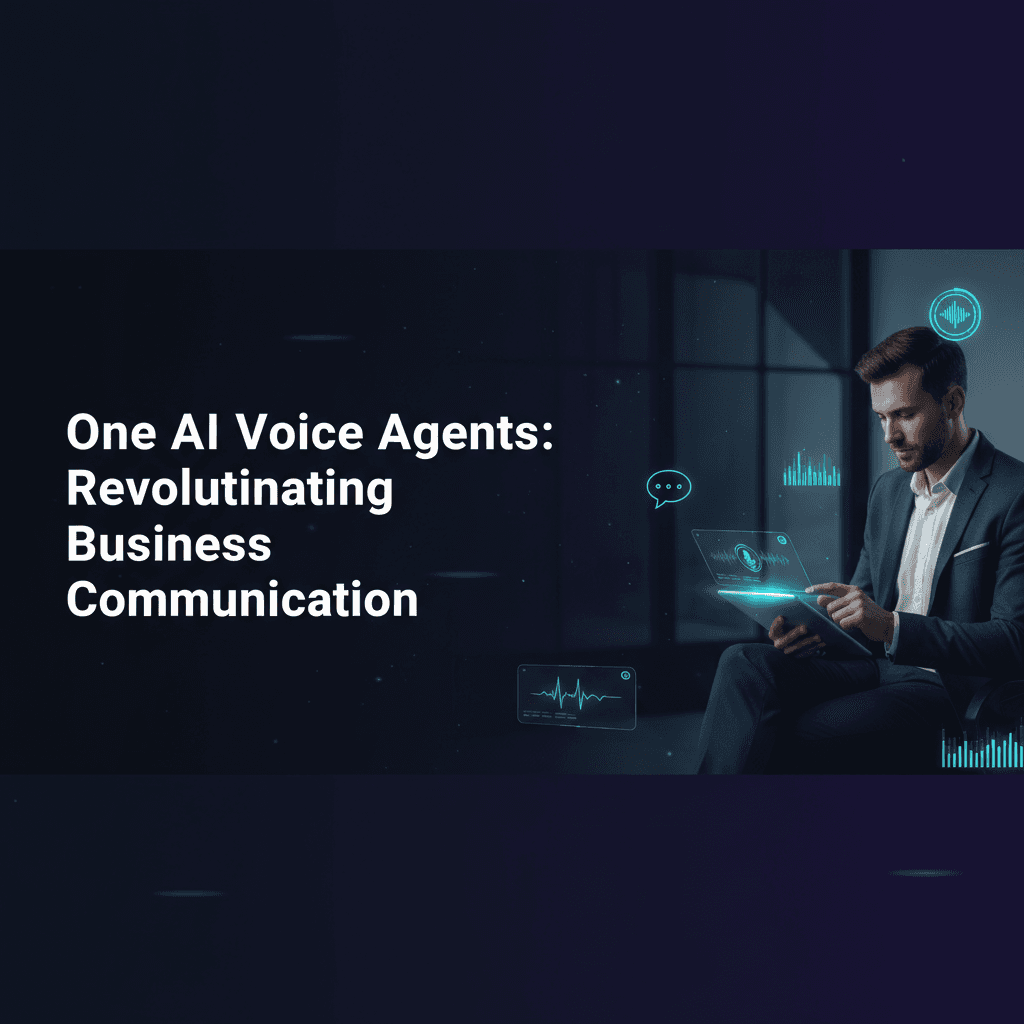
The landscape of business communication is undergoing a seismic shift, driven by the rapid evolution of artificial intelligence. At the forefront of this transformation are one AI voice agents, sophisticated systems designed to interact with customers and prospects in ways previously unimaginable. Gone are the days of frustrating, rigid interactive voice response (IVR) systems. We're now entering an era where AI-powered conversations are natural, efficient, and deeply personalized. This article delves into the exciting world of AI voice agents, exploring their current capabilities, future trends, and how they are set to redefine customer interactions by 2026 and beyond.
The Rise of Autonomous AI Voice Agents
The most significant leap in recent years has been the development of autonomous AI voice agents. Unlike their predecessors, these agents aren't just following scripts; they can understand context, learn from interactions, and make decisions in real-time. This autonomy is crucial for delivering truly seamless customer experiences. Imagine an AI voice agent for customer service that can resolve complex queries, process returns, or even troubleshoot technical issues without human intervention. This level of self-sufficiency is what makes the current generation of AI voice agents so powerful.
Beyond IVR: Natural Conversation AI Voice Agents
One of the biggest differentiators between traditional IVR and modern AI voice agents is the ability to engage in natural conversation AI voice agents. This means understanding nuances, handling interruptions, and responding in a way that feels human-like. The days of pressing '1' for sales or '2' for support are numbered. Instead, customers can simply state their needs, and the AI agent will intelligently route or resolve their query. This shift is particularly impactful for improving customer satisfaction and reducing frustration, a common complaint with older systems. The contrast between an AI voice agent vs IVR couldn't be starker, with AI offering a far superior user experience.
Key AI Voice Agent Trends for 2026
As we look towards AI voice agents 2026, several key trends are emerging that will shape the future of this technology:
Emotion-Aware AI Voice Agents
The ability of emotion aware AI voice agents to detect and respond to human emotions will be a game-changer. By understanding whether a customer is frustrated, happy, or confused, the AI can adapt its tone and approach, leading to more empathetic and effective interactions. This is particularly valuable in high-stakes customer service scenarios.
Low Latency AI Voice Agents
For natural conversations, speed is paramount. Low latency AI voice agents will ensure that responses are delivered almost instantaneously, eliminating awkward pauses and making interactions feel more fluid and human-like. This technological advancement is crucial for maintaining engagement and preventing customer drop-off.
Multilingual AI Voice Agents
Global businesses require global solutions. Multilingual AI voice agents will become standard, allowing companies to serve diverse customer bases in their native languages without the need for extensive human translation teams. This expands market reach and enhances customer experience significantly.
Best AI Voice Agent Platforms and Solutions
Choosing the best AI voice agent platforms is critical for successful implementation. While the market is dynamic, leading platforms offer robust features like natural language understanding (NLU), speech-to-text and text-to-speech capabilities, integration with CRM systems, and analytics. Many are also moving towards a no code AI voice agent platform model, making it easier for businesses of all sizes to deploy sophisticated AI solutions without deep technical expertise.
AI Voice Agents in Action: Specific Business Applications
The versatility of one AI voice agents means they can be deployed across a multitude of business functions, delivering tangible benefits:
AI Voice Agent for Call Centers
In call centers, AI agents can handle routine inquiries, freeing up human agents for more complex issues. An AI voice agent for call centers can significantly reduce wait times, improve first-call resolution rates, and operate 24/7, leading to substantial cost savings and enhanced customer satisfaction.
AI Voice Assistant for Appointments
Scheduling and managing appointments can be a major time sink. An AI voice assistant for appointments can handle bookings, send reminders, and even reschedule appointments autonomously, benefiting healthcare providers, salons, and various service industries.
AI Voice Agent for Sales Qualification
Sales teams can leverage AI voice agent for sales qualification to pre-screen leads, gather essential information, and identify high-potential prospects. This ensures that human sales representatives spend their valuable time on qualified leads, boosting efficiency and conversion rates.
AI Voice Agent for Small Business
Small businesses, often with limited resources, can particularly benefit. An AI voice agent for small business can provide 24/7 customer support, handle basic inquiries, and manage appointments, giving them a competitive edge without the overhead of additional staff.
The Future is Conversational: AI Voice Agents 2026 and Beyond
The market for AI voice agents is projected to surpass $22 billion, underscoring the immense value and adoption rate of this technology. The shift from rigid, menu-driven interactions to intelligent, autonomous, and emotion-aware conversations is not just an upgrade; it's a fundamental change in how businesses connect with their customers. By embracing the latest AI voice agent trends 2026, companies can unlock new levels of efficiency, customer satisfaction, and operational excellence. The future of communication is undoubtedly conversational, and one AI voice agents are leading the charge.
Frequently Asked Questions About AI Voice Agents
Q: What is the main difference between an AI voice agent and traditional IVR?
A: The main difference lies in their conversational capabilities. Traditional IVR systems are menu-driven and rigid, requiring users to follow specific prompts. AI voice agents, particularly natural conversation AI voice agents, use advanced AI to understand natural language, context, and intent, allowing for more fluid, human-like interactions. They can handle complex queries and adapt to the conversation in real-time, making the experience far more intuitive and less frustrating than a typical AI voice agent vs IVR comparison would highlight.
Q: How can an AI voice agent benefit my small business?
A: An AI voice agent for small business offers numerous benefits, including 24/7 customer support without additional staff, automated appointment scheduling (an AI voice assistant for appointments), improved lead qualification, and handling of routine inquiries. This frees up valuable time for small business owners and their teams to focus on growth and more complex tasks, providing a competitive edge and enhancing customer experience.
Q: What are the expected advancements for AI voice agents by 2026?
A: By AI voice agents 2026, we expect significant advancements, including more sophisticated emotion aware AI voice agents that can detect and respond to user emotions, further development of low latency AI voice agents for seamless conversations, and widespread adoption of multilingual AI voice agents. Additionally, autonomous AI voice agents will become even more capable of handling complex, end-to-end tasks without human intervention, driven by the latest AI voice agent trends 2026.
Q: Are there 'no-code' options for implementing AI voice agents?
A: Yes, the market is seeing a growing number of no code AI voice agent platform options. These platforms allow businesses to design, deploy, and manage AI voice agents without requiring extensive programming knowledge. This democratizes access to advanced AI technology, making it easier for businesses of all sizes to leverage the power of one AI voice agents for various applications like customer service and sales qualification.