





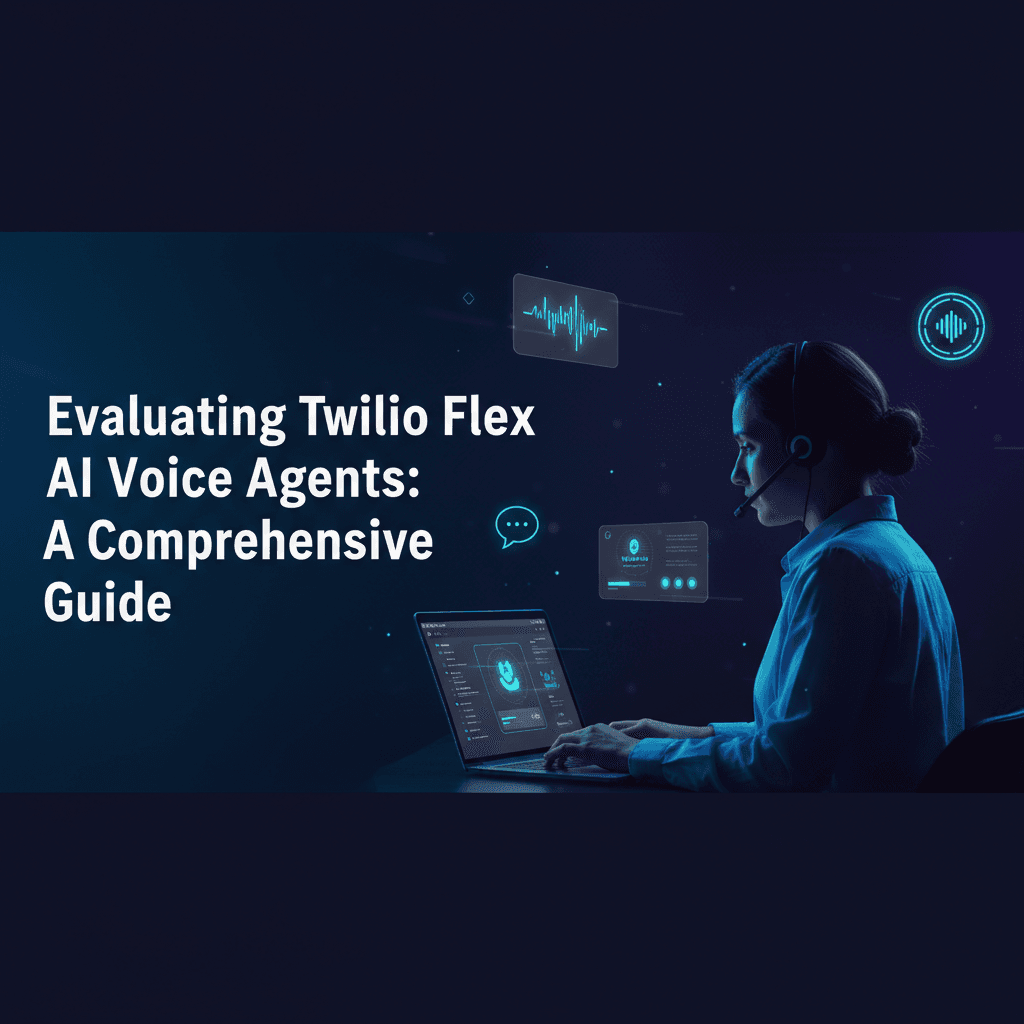
In today's fast-paced customer service landscape, AI voice agents are no longer a luxury but a necessity. Twilio Flex, with its highly customizable platform, empowers businesses to deploy sophisticated conversational AI solutions. However, simply deploying an AI agent isn't enough; the true challenge lies in effectively evaluating its performance to ensure it delivers tangible business value. This comprehensive guide will delve into the critical aspects of twilio flex ai voice agents evaluation, covering everything from core metrics to advanced observability and iteration strategies.
Why Robust AI Voice Agent Evaluation is Crucial
The success of your Twilio Flex AI voice agents directly impacts customer satisfaction, operational efficiency, and ultimately, your bottom line. Without a clear framework for how to evaluate ai voice agents on twilio flex, you risk deploying solutions that underperform, frustrate customers, and fail to meet business objectives. Effective evaluation allows for continuous improvement, ensuring your AI agents evolve with customer needs and technological advancements.
Key Performance Metrics for Twilio Flex AI Voice Agents
To truly understand your twilio flex ai voice agent performance metrics, you need to look beyond basic call counts. Here are some essential metrics to track:
Customer Satisfaction (CSAT) and Resolution Rates
These are paramount. Twilio Flex AI voice agent CSAT and resolution rates directly reflect the quality of interaction and the agent's ability to solve customer issues. Implement post-interaction surveys or sentiment analysis to gauge CSAT. For resolution rates, track how often the AI agent successfully resolves a query without human intervention.
First-Call Resolution (FCR) Evaluation
A high twilio flex ai voice agent first-call resolution evaluation score indicates efficiency and customer satisfaction. This metric focuses on the AI's ability to resolve an issue completely in the first interaction, reducing repeat calls and customer effort.
IVR Replacement Rate Metrics
For businesses transitioning from traditional IVRs, the twilio flex ai voice agent IVR replacement rate metrics are vital. This measures how effectively your AI agent handles tasks previously managed by a touch-tone IVR, indicating successful automation and improved customer experience.
Latency and Handoff Efficiency
Measuring twilio flex ai voice agent latency and handoff is crucial for a seamless customer experience. High latency can lead to frustrating pauses, while inefficient handoffs to human agents can negate the benefits of AI. Monitor response times and the smooth transition of context during escalations.
Conversation Quality and Confidence Tracking
Beyond resolution, the quality of interaction matters. Evaluating twilio flex ai agent conversation quality involves analyzing dialogue flow, natural language understanding (NLU) accuracy, and sentiment. Additionally, twilio flex ai voice agent confidence tracking metrics can reveal instances where the AI is unsure, indicating areas for model improvement or a need for human intervention.
Building Observability for Twilio Flex AI Voice Agents
Observability is key to understanding and improving your AI agents. You need to build observability for twilio flex ai voice agents to gain insights into their real-time performance and identify issues proactively. This involves collecting and analyzing data across various stages of the interaction.
Tools and Techniques for Evaluation and Testing
Leveraging the right twilio flex conversational ai agent testing tools is essential. This can range from built-in Twilio logging and analytics to external platforms that offer deeper insights into NLU and dialogue management. Consider:
Automated Testing Frameworks
For robust testing, consider using a tool like fixa python package for twilio flex ai voice agent testing. Fixa allows you to create automated test suites that simulate user interactions, validate responses, and identify regressions before they impact live customers. This is crucial for maintaining quality as your AI agent evolves.
Drift Detection and Evaluation
AI models can experience 'drift' over time as user behavior or underlying data changes. Implementing twilio flex ai voice agent drift detection and evaluation mechanisms is vital. This involves regularly comparing current performance against a baseline to identify when the model's accuracy or effectiveness begins to degrade, prompting retraining or adjustments.
Evaluating Business Outcomes
Ultimately, your AI voice agents must contribute to your business goals. This means focusing on twilio flex voice ai business outcomes evaluation. Look at metrics like reduced operational costs, increased agent productivity (by offloading routine tasks), improved customer loyalty, and even increased sales if the AI is designed for lead generation or upselling.
Pilot and Iteration Strategy
A successful AI agent deployment rarely happens overnight. Adopt a robust twilio flex ai agent pilot and iteration strategy. Start with a smaller pilot group, gather data, analyze performance, and then iterate. This iterative approach allows you to refine your AI agent based on real-world interactions before a full-scale rollout, minimizing risks and maximizing effectiveness.
Conclusion
Evaluating your Twilio Flex AI voice agents is an ongoing process that requires a combination of technical metrics, customer feedback, and business outcome analysis. By focusing on comprehensive twilio flex ai voice agents evaluation, building strong observability, and adopting an iterative improvement strategy, you can ensure your conversational AI delivers exceptional value and a superior customer experience.
Frequently Asked Questions (FAQ)
What are the most important metrics for Twilio Flex AI voice agent performance?
Key metrics include Customer Satisfaction (CSAT), First-Call Resolution (FCR), Resolution Rate, IVR Replacement Rate, Latency, Handoff Efficiency, and Conversation Quality. These provide a holistic view of both customer experience and operational effectiveness.
How can I build observability for my Twilio Flex AI voice agents?
To build observability for twilio flex ai voice agents, integrate Twilio's native logging and analytics with external monitoring tools. Track interaction logs, NLU confidence scores, sentiment analysis, and agent handoff events. This data helps identify patterns and areas for improvement.
What is AI voice agent drift detection and why is it important?
Twilio Flex AI voice agent drift detection and evaluation refers to monitoring changes in your AI model's performance over time due to evolving user behavior or data. It's crucial because drift can lead to decreased accuracy and customer dissatisfaction. Detecting it early allows for timely retraining and model updates.
Can I automate testing for my Twilio Flex AI voice agents?
Yes, automated testing is highly recommended. Tools like the fixa python package for twilio flex ai voice agent testing allow you to create scripts that simulate user interactions, validate AI responses, and ensure consistent performance across updates, significantly improving your twilio flex conversational ai agent testing tools arsenal.
How do I evaluate the business outcomes of my Twilio Flex AI voice agents?
To conduct twilio flex voice ai business outcomes evaluation, link AI agent performance to key business metrics such as reduced average handle time (AHT), decreased call center costs, increased agent availability for complex issues, improved customer retention, and potentially higher revenue from AI-driven interactions. This demonstrates the ROI of your AI investment.