



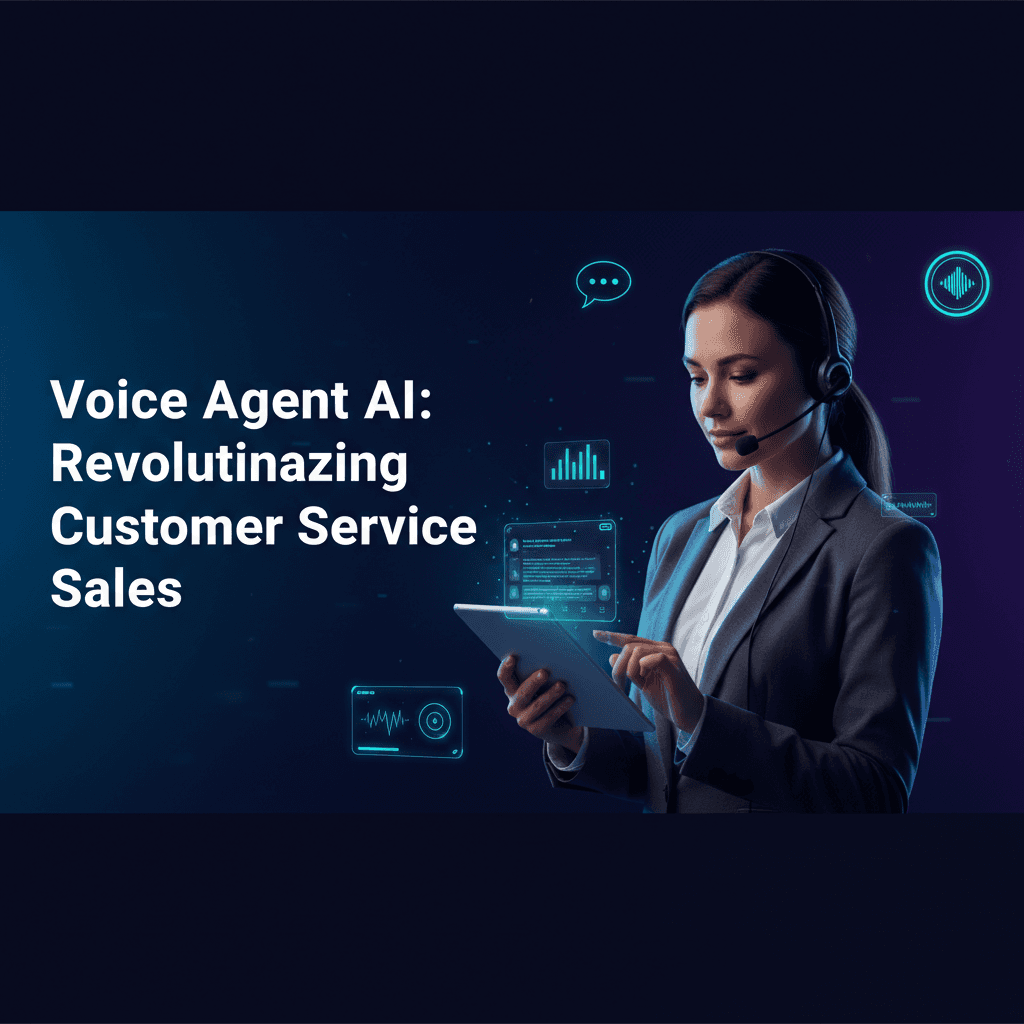
In today’s fast-paced digital landscape, businesses are constantly seeking innovative ways to enhance customer interactions and streamline operations. Enter the voice agent AI – a groundbreaking technology that's reshaping how companies communicate with their clientele. Far beyond simple chatbots, these intelligent systems leverage advanced artificial intelligence to understand, process, and respond to human speech, offering a seamless and efficient experience. Whether you're looking to improve customer support, boost sales, or automate routine tasks, understanding the capabilities of a modern AI voice agent is crucial for staying competitive.
What is a Voice Agent AI?
At its core, a voice agent AI is an artificial intelligence system designed to interact with humans using spoken language. Unlike traditional interactive voice response (IVR) systems that rely on rigid menus and button presses, an AI voice agent utilizes natural language processing (NLP) and machine learning to understand the nuances of human speech. This allows for more natural, free-flowing conversations, making interactions feel less robotic and more human-like. These systems are powered by sophisticated speech-to-text and text-to-speech AI technologies, enabling them to convert spoken words into data for processing and then generate spoken responses.
How Does a Voice AI Agent Work?
The magic behind a voice AI agent lies in its complex architecture. When a user speaks, the system first employs advanced speech-to-text AI to transcribe the audio into text. This text is then fed into a natural language understanding (NLU) module, which interprets the speaker's intent and extracts relevant information. Modern LLM voice agents (Large Language Model voice agents) leverage powerful models to comprehend context, handle complex queries, and even maintain conversational flow over extended interactions. Once the intent is understood, the system generates an appropriate response, which is then converted back into spoken language using text-to-speech AI. This entire process happens in milliseconds, creating a seamless and responsive experience for the user.
Key Benefits of Implementing a Voice Agent Platform
Adopting a robust voice agent platform can bring a multitude of advantages to businesses across various sectors. Here are some of the most significant:
Enhanced Customer Experience
Customers today expect instant gratification and personalized service. A conversational AI voice assistant can provide 24/7 support, reducing wait times and resolving queries quickly. The ability of a natural language voice agent to understand and respond in a human-like manner significantly improves customer satisfaction, leading to increased loyalty and positive brand perception.
Increased Efficiency and Cost Savings
Automating routine inquiries and tasks with voice assistant automation frees up human agents to focus on more complex issues. This not only boosts productivity but also drastically reduces operational costs associated with staffing and training. An AI call center agent can handle a high volume of calls simultaneously, ensuring no customer is left waiting.
Scalability and Availability
Unlike human teams, a voice agent AI can scale instantly to meet fluctuating demand, whether it's during peak seasons or unexpected events. This ensures consistent service quality and availability around the clock, regardless of geographical location or time zones.
Applications of Voice Agent AI Across Industries
The versatility of voice agent AI means it can be deployed in numerous scenarios:
Voice Agent for Customer Service
This is perhaps the most common application. A voice agent for customer service can handle FAQs, provide account information, process orders, schedule appointments, and even troubleshoot basic technical issues. The goal is to resolve common queries quickly, allowing human agents to focus on more complex or sensitive customer interactions. An enterprise voice agent can be specifically tailored to the unique needs and vocabulary of large organizations.
AI Phone Agent for Sales Calls
Voice AI for sales calls is emerging as a powerful tool for lead qualification, appointment setting, and even closing simple sales. An AI phone agent can engage potential customers, answer product questions, and guide them through the sales funnel, significantly increasing efficiency for sales teams. An autonomous voice agent can even conduct entire sales conversations from start to finish, qualifying leads and setting up follow-ups.
Voice Bot for Calls and General Automation
Beyond customer service and sales, a voice bot for calls can automate a wide range of internal and external processes. This includes internal help desks, HR inquiries, IT support, and even data collection. The potential for voice assistant automation is vast, freeing up resources across an organization.
Choosing the Right Voice Agent Platform
When selecting a voice agent platform, consider several factors to ensure it aligns with your business needs:
- Natural Language Understanding (NLU) Capabilities: How well does the natural language voice agent understand complex queries, accents, and conversational nuances?
- Integration: Can it seamlessly integrate with your existing CRM, ERP, and other business systems?
- Scalability: Can the platform handle your current and future call volumes without performance degradation?
- Customization: Can you tailor the voice agent's personality, responses, and knowledge base to match your brand?
- Security and Compliance: Does the platform meet industry-specific security standards and data privacy regulations?
- Analytics and Reporting: Does it provide robust tools to monitor performance, identify trends, and continuously improve the agent's effectiveness?
- Support for LLM Voice Agent Features: Does it leverage the latest in large language models for superior conversational abilities?
The Future of Voice Agent AI
The evolution of voice agent AI is far from over. With continuous advancements in machine learning, deep learning, and especially large language models, these systems are becoming increasingly sophisticated. We can expect even more human-like interactions, greater emotional intelligence, and the ability to handle even more complex, multi-turn conversations. The rise of the truly autonomous voice agent promises to further redefine customer service and business operations, making interactions more efficient, personalized, and accessible for everyone.
Conclusion
The integration of voice agent AI is no longer a futuristic concept but a present-day necessity for businesses aiming for operational excellence and superior customer engagement. By embracing an advanced AI voice agent, companies can unlock unprecedented levels of efficiency, cost savings, and customer satisfaction. The journey towards a fully automated, intelligent conversational experience is well underway, and businesses that invest in a robust voice agent platform today will be well-positioned for success tomorrow.
Frequently Asked Questions about Voice Agent AI
What is the difference between a voice agent AI and an IVR system?
Traditional IVR (Interactive Voice Response) systems rely on pre-recorded messages and menu options that require users to press buttons. A voice agent AI, on the other hand, uses natural language processing (NLP) and machine learning to understand spoken language, allowing for more fluid, human-like conversations and the ability to handle complex, unscripted queries, similar to a conversational AI voice assistant.
Can a voice agent AI understand different accents?
Yes, modern AI voice agents are trained on vast datasets of speech, enabling them to recognize and understand a wide range of accents and dialects. Advanced speech-to-text AI algorithms continuously improve their accuracy, making them highly adaptable to diverse linguistic patterns.
Is an LLM voice agent better than a traditional voice bot?
Generally, an LLM voice agent offers superior conversational capabilities compared to traditional voice bots. Large Language Models allow the agent to understand context better, generate more nuanced and coherent responses, and handle a wider array of complex and open-ended questions, leading to a much more natural and effective interaction.
What industries benefit most from a voice agent for customer service?
Industries with high call volumes and repetitive inquiries, such as telecommunications, banking, healthcare, retail, and travel, can significantly benefit from a voice agent for customer service. It helps automate routine tasks, reduce wait times, and improve overall service efficiency. An AI call center agent can be a game-changer in these sectors.
How can voice AI for sales calls improve my business?
Voice AI for sales calls can significantly improve your business by automating lead qualification, conducting initial outreach, answering common product questions, and even scheduling demos. This allows your human sales team to focus on high-value prospects and closing deals, boosting overall sales productivity and efficiency. An AI phone agent can also ensure consistent messaging and follow-up.