



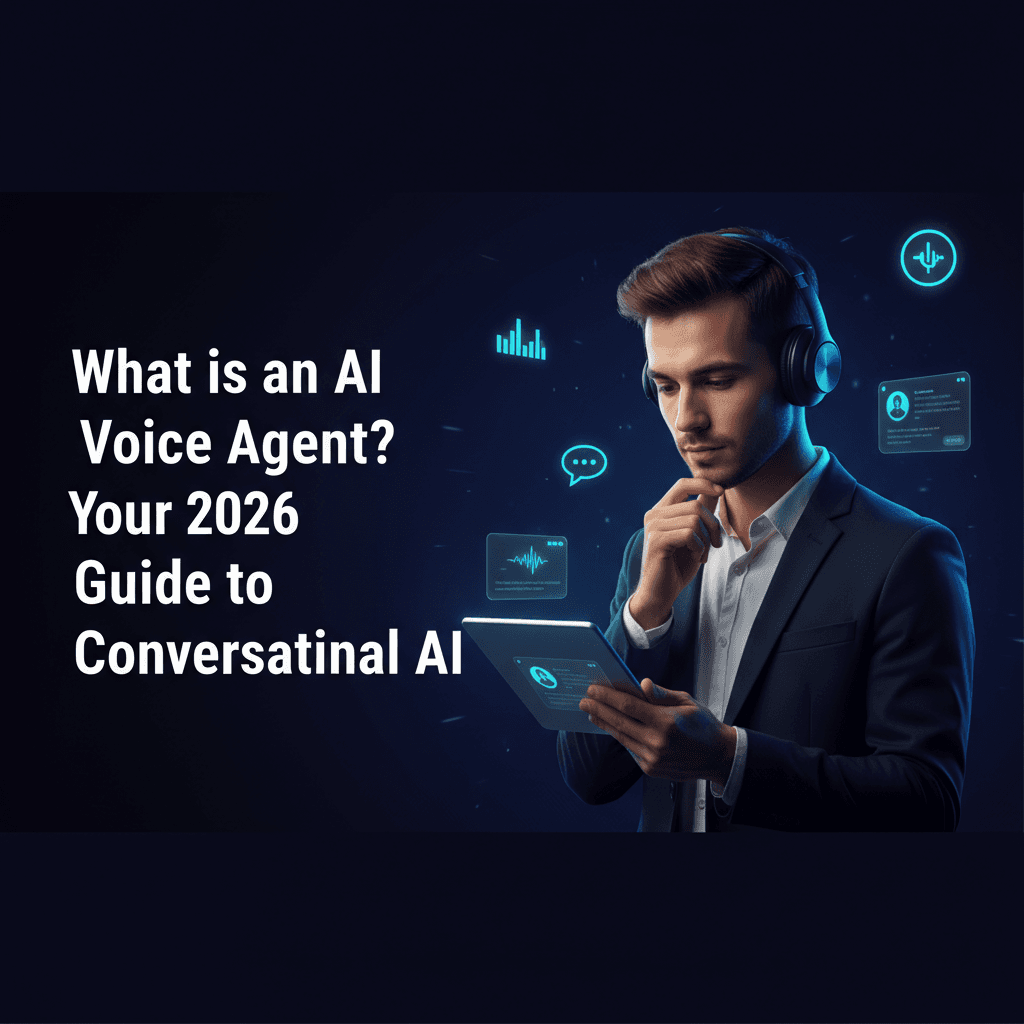
In an increasingly digital world, businesses are constantly seeking innovative ways to enhance customer interactions and streamline operations. Enter the AI voice agent – a sophisticated technological marvel transforming how companies communicate. But what exactly is an AI voice agent, and how is it evolving in 2026? This comprehensive guide will demystify this powerful tool, exploring its core functionalities, key benefits, and diverse applications across various industries.
Defining the AI Voice Agent: More Than Just a Robot
At its heart, an AI voice agent is an artificial intelligence program designed to interact with humans through spoken language. Unlike traditional, rule-based systems, these agents leverage advanced machine learning, natural language processing (NLP), and speech recognition to understand, interpret, and respond to human speech in a highly intelligent and contextual manner. They can conduct natural, free-flowing conversations, answer questions, perform tasks, and even express empathy, making them invaluable assets for businesses aiming to provide superior customer experiences.
How AI Voice Agents Work in 2026: A Deep Dive
The sophistication of how AI voice agents work in 2026 is a testament to rapid advancements in AI. The process typically involves several interconnected components:
1. Speech-to-Text (STT) Conversion
When a user speaks, the agent's first step is to convert the audio into text. This is where AI voice agent speech to text technology comes into play, accurately transcribing spoken words into a format the AI can process. Modern STT systems are highly accurate, even in noisy environments or with varied accents.
2. Natural Language Processing (NLP) and Understanding (NLU)
Once the speech is converted to text, NLP algorithms analyze the text to understand its meaning, intent, and context. This includes identifying keywords, entities, and the overall sentiment of the user's query. AI voice agent natural language processing examples include understanding complex questions, recognizing sarcasm, and discerning subtle nuances in human speech.
3. Dialogue Management
This component manages the flow of the conversation, tracking context, remembering previous turns, and determining the most appropriate next action or response. It allows for multi-turn conversations that feel natural and coherent.
4. Text-to-Speech (TTS) Synthesis
Finally, the AI generates a textual response, which is then converted back into natural-sounding speech using advanced AI voice agent text to speech technology. Modern TTS systems can produce highly realistic and emotionally expressive voices, often indistinguishable from human speech.
AI Voice Agent vs. IVR System: A Clear Distinction
One of the most common comparisons is between an AI voice agent vs ivr system. While both interact with callers, their underlying technology and capabilities are vastly different:
Traditional IVR (Interactive Voice Response)
IVR systems are menu-driven and rely on pre-recorded prompts and touch-tone inputs (or simple keyword recognition). They are rigid, linear, and often frustrating for callers who don't fit into predefined categories. Think of the classic "Press 1 for sales, press 2 for support" scenarios.
AI Voice Agent
In contrast, an AI voice agent offers a conversational experience. It understands natural language, can handle complex queries, switch topics, and adapt to the user's needs in real-time. This leads to significantly improved customer satisfaction and efficiency.
AI Voice Agent vs. Chatbot: Understanding the Medium
Another common comparison involves the AI voice agent vs chatbot differences. While both are conversational AI, the medium is the key differentiator:
AI Voice Agents
Operate via spoken language, ideal for phone calls, smart speakers, and hands-free interactions. They excel in situations where typing is inconvenient or impossible, offering a more personal and immediate connection.
Chatbots
Communicate via text, typically on websites, messaging apps, or social media. They are excellent for quick information retrieval and asynchronous communication.
Benefits of AI Voice Agents for Customer Service
The advantages of deploying AI voice agents for customer service are numerous and impactful:
- 24/7 Availability: AI agents never sleep, providing round-the-clock support.
- Instant Responses: Eliminate wait times with real time AI voice agent capabilities, resolving queries instantly.
- Scalability: Handle an unlimited number of calls simultaneously without increasing headcount.
- Cost Reduction: Significantly lower operational costs compared to human agents. The AI voice agent cost per minute in 2026 is projected to be highly competitive, offering substantial savings.
- Improved Customer Satisfaction: Offer consistent, accurate, and personalized service, leading to happier customers.
- Personalization: Leverage data to provide tailored interactions and recommendations.
- Multilingual Support: Easily configured to support multiple languages, expanding global reach.
- Reduced Agent Burnout: Automate repetitive tasks, allowing human agents to focus on complex issues.
Key AI Voice Agent Use Cases in 2026
AI voice agents are versatile and finding applications across various sectors:
Customer Support & Call Centers
Handling FAQs, order status inquiries, technical support, and routing complex calls to human agents. This is the future of AI voice agents in contact centers.
Healthcare
AI voice agent use cases in healthcare include patient appointment scheduling, prescription refills, answering common health questions, and providing information on services. An AI voice agent for appointment scheduling can significantly reduce administrative burden.
Sales & Marketing
Performing AI voice agent for lead qualification and screening, providing product information, and even assisting with sales inquiries.
Banking & Finance
Account balance checks, transaction history, fraud alerts, and loan application assistance.
Integrating AI Voice Agents with Existing Systems
For enterprises, seamless integration is crucial. AI voice agent integration with CRM systems (like Salesforce or HubSpot) allows agents to access and update customer data in real-time, providing a truly personalized experience. This connectivity ensures that every interaction is informed by a complete customer history, enhancing efficiency and effectiveness.
Choosing the Best AI Voice Agent Platforms for Enterprises
When selecting the best AI voice agent platforms for enterprises, consider factors such as scalability, integration capabilities, NLP accuracy, customization options, and security. Leading platforms often offer robust APIs, pre-built integrations, and intuitive interfaces for managing conversational flows. Many also provide low-code or no-code solutions, making it easier to build an AI voice agent without coding, empowering businesses to deploy solutions quickly and efficiently.
Conclusion
The AI voice agent is no longer a futuristic concept but a present-day reality revolutionizing customer interactions. With continuous advancements in AI, these agents are becoming more intelligent, empathetic, and indispensable for businesses aiming to stay competitive. As we move further into 2026 and beyond, expect AI voice agents to play an even more central role in shaping the landscape of customer service and operational efficiency.
Frequently Asked Questions About AI Voice Agents
Q: What is the primary difference between an AI voice agent and an IVR system?
A: The primary difference lies in their intelligence and flexibility. An IVR system is rigid and menu-driven, relying on pre-programmed options. An AI voice agent, however, uses natural language processing to understand and respond to complex, free-form human speech, offering a much more natural and conversational experience.
Q: Can AI voice agents integrate with existing CRM systems?
A: Yes, seamless AI voice agent integration with CRM systems is a key capability for enterprise solutions. This allows the AI agent to access customer histories, preferences, and other relevant data in real-time, enabling personalized interactions and efficient task completion.
Q: What are some common AI voice agent use cases in healthcare?
A: AI voice agent use cases in healthcare are diverse, including AI voice agent for appointment scheduling, providing information on clinic hours or services, answering FAQs about common conditions, assisting with prescription refills, and even offering preliminary symptom assessment (though always under human supervision for critical care).
Q: How much does an AI voice agent cost per minute in 2026?
A: The AI voice agent cost per minute in 2026 varies significantly based on the platform, complexity of the dialogue, volume of interactions, and specific features utilized. However, generally, AI voice agents offer a much lower cost per interaction compared to human agents, leading to substantial long-term savings for businesses.
Q: Is it possible to build an AI voice agent without coding?
A: Yes, many modern platforms offer low-code or no-code solutions that allow users to build an AI voice agent without coding. These platforms typically feature intuitive drag-and-drop interfaces, pre-built templates, and visual flow builders, making AI voice agent deployment accessible to a wider range of businesses.