




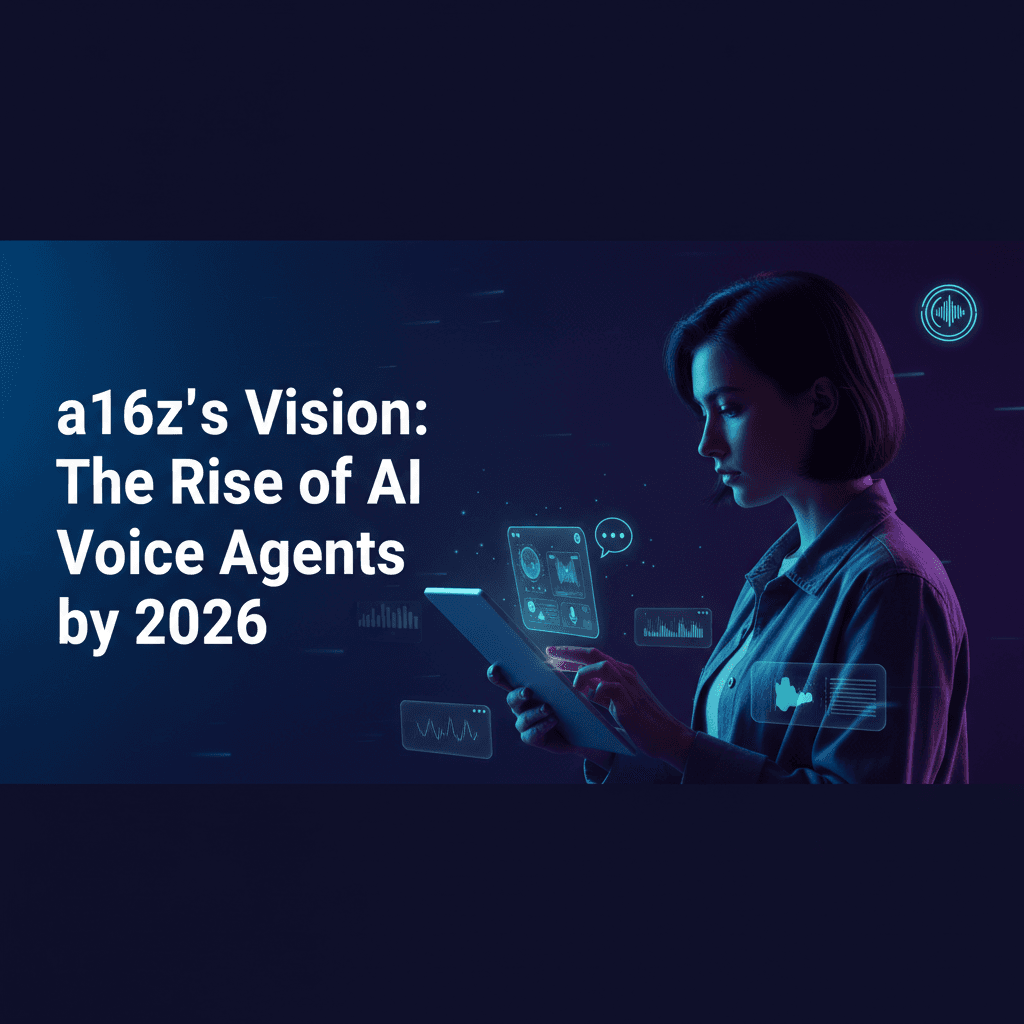
The landscape of artificial intelligence is evolving at an unprecedented pace, with AI voice agents emerging as a transformative technology. Venture capital giant a16z has laid out a compelling thesis regarding the future of these agents, predicting a significant shift in their capabilities and widespread adoption by 2026. This isn't just about simple chatbots; we're talking about sophisticated, intelligent systems capable of handling complex interactions, driving enterprise deployment, and fundamentally altering how we engage with technology and services. From replacing mundane phone workflows to enabling proactive continuous health monitoring, the potential is vast and multifaceted.
The a16z Thesis on AI Voice Agents: A 2026 Outlook
a16z's vision for AI voice agents by 2026 is ambitious, moving beyond mere task automation to truly intelligent, context-aware conversational partners. Their thesis suggests a future where these agents are not just productivity tools but integral components of our daily lives, seamlessly integrated into various sectors. This involves a maturation of underlying AI technologies, enabling more natural language understanding, emotional intelligence, and the ability to handle multi-modal workflows. The focus is on creating zero visible prompting AI apps 2026, where interactions feel intuitive and human-like, almost as if the AI anticipates our needs.
Enterprise Deployment and Sector-Specific Impact
One of the core tenets of the a16z thesis is the massive scale of ai voice agents enterprise deployment 2026. Industries previously reliant on manual processes are ripe for disruption. Consider the impact on customer service, sales, and internal operations. AI voice agents are set to revolutionize these areas, offering efficiency and scalability previously unattainable.
Healthcare Transformation with AI Voice Agents
The healthcare sector stands to gain immensely from the advanced capabilities of ai voice agents healthcare 2026. Imagine personalized health assistants providing proactive continuous health monitoring ai, reminding patients about medication, scheduling appointments, or even offering initial symptom assessments. In assisted living and nursing homes, ai voice agents assisted living nursing homes can provide companionship, emergency alerts, and facilitate communication with family members, vastly improving quality of life and operational efficiency. The ability of these agents to operate effectively in regulated environments is crucial for widespread adoption in this sensitive sector.
Reshaping Banking and Financial Services
Similarly, ai voice agents banking financial services are poised to redefine customer interactions. From handling routine inquiries like balance checks and transaction history to assisting with loan applications and fraud detection, these agents can significantly reduce wait times and improve customer satisfaction. The critical aspect here is ensuring trust and reliability ai voice agents, especially when dealing with sensitive financial data. Compliance with stringent regulations within ai voice agents regulated environments will be paramount.
Beyond Productivity: Consumer Connectivity and Lifestyle
While enterprise applications are significant, a16z also highlights the burgeoning role of consumer ai voice agents connectivity 2026. This isn't just about smart speakers; it's about deeply integrated AI that understands user preferences, anticipates needs, and facilitates seamless interactions across devices and platforms. Imagine AI voice agents replacing phone workflows for everything from ordering groceries to managing smart home devices, all with natural, conversational interfaces.
Recruiting Automation and Other B2B Applications
The impact extends to specialized business functions, such as ai voice agents recruiting automation. These agents can screen candidates, schedule interviews, and answer frequently asked questions, streamlining the hiring process and freeing up human recruiters for more strategic tasks. This illustrates the broader trend of ai voice agents b2b vs b2c 2026, where both sectors will see profound changes, albeit with different implementation strategies and regulatory considerations.
The Technology Driving the Revolution: Vapi, ElevenLabs, Cartesia
The advancements predicted by a16z are underpinned by significant technological breakthroughs. Companies like Vapi, ElevenLabs, and Cartesia Voice AI are at the forefront of developing the sophisticated tools necessary for these agents. Vapi provides a robust platform for building conversational AI, while ElevenLabs excels in generating highly realistic and expressive synthetic speech. Cartesia Voice AI further pushes the boundaries of voice synthesis and understanding, contributing to the seamless, natural interactions that define the next generation of AI voice agents. These innovations are crucial for enabling ai voice agents multi-modal workflows, allowing them to understand and respond not just to voice, but also to visual cues and other forms of input.
Overcoming Challenges: Trust, Reliability, and Regulation
While the potential is immense, the widespread adoption of AI voice agents, particularly in sensitive sectors, hinges on addressing critical concerns. Trust and reliability ai voice agents are paramount. Users need to be confident that these agents are secure, accurate, and ethical. This is especially true for ai voice agents regulated environments like healthcare and finance, where data privacy and compliance are non-negotiable. Developers and enterprises must prioritize robust security measures, transparent AI models, and clear ethical guidelines to foster public confidence and ensure responsible deployment.
The Road Ahead: 2026 and Beyond
a16z's 2026 predictions for AI voice agents paint a picture of a world where intelligent conversational AI is deeply embedded in both our personal and professional lives. The shift from basic productivity tools to sophisticated, context-aware agents capable of complex interactions is already underway. As technologies like Vapi, ElevenLabs, and Cartesia continue to advance, and as enterprises navigate the challenges of trust and regulation, the vision of a truly intelligent, voice-driven future seems not just plausible, but inevitable. The coming years will be crucial in shaping how these powerful tools are integrated into society, promising a future of enhanced efficiency, accessibility, and connectivity.
Frequently Asked Questions About AI Voice Agents
What is the a16z thesis on AI voice agents?
The a16z thesis on AI voice agents predicts a significant evolution and widespread adoption by 2026. It foresees these agents moving beyond simple task automation to become intelligent, context-aware conversational partners, driving massive enterprise deployment and transforming sectors like healthcare, banking, and consumer connectivity. The goal is to achieve zero visible prompting AI apps 2026, making interactions seamless and intuitive.
How will AI voice agents impact healthcare by 2026?
By 2026, ai voice agents healthcare 2026 are expected to revolutionize patient care through proactive continuous health monitoring ai, medication reminders, appointment scheduling, and initial symptom assessment. They will also play a crucial role in ai voice agents assisted living nursing homes, providing companionship, emergency alerts, and facilitating communication, all while operating within ai voice agents regulated environments.
What role will AI voice agents play in banking and financial services?
In banking and financial services, ai voice agents banking financial services will handle routine inquiries, assist with loan applications, and aid in fraud detection. Their deployment will focus on improving customer experience and efficiency. Ensuring trust and reliability ai voice agents and strict adherence to regulations within ai voice agents regulated environments will be critical for their success.
How will consumer AI voice agents evolve by 2026?
Consumer ai voice agents connectivity 2026 will move beyond simple smart speakers to become deeply integrated, personalized assistants. They will anticipate user needs, facilitate seamless interactions across devices, and replace phone workflows for various daily tasks, offering a more intuitive and connected lifestyle.
What technologies are driving the development of these advanced AI voice agents?
Key technologies include platforms like Vapi for building conversational AI, ElevenLabs for highly realistic synthetic speech generation, and Cartesia Voice AI for advanced voice synthesis and understanding. These innovations are crucial for enabling ai voice agents multi-modal workflows and creating the natural, zero visible prompting AI apps 2026 experience.