



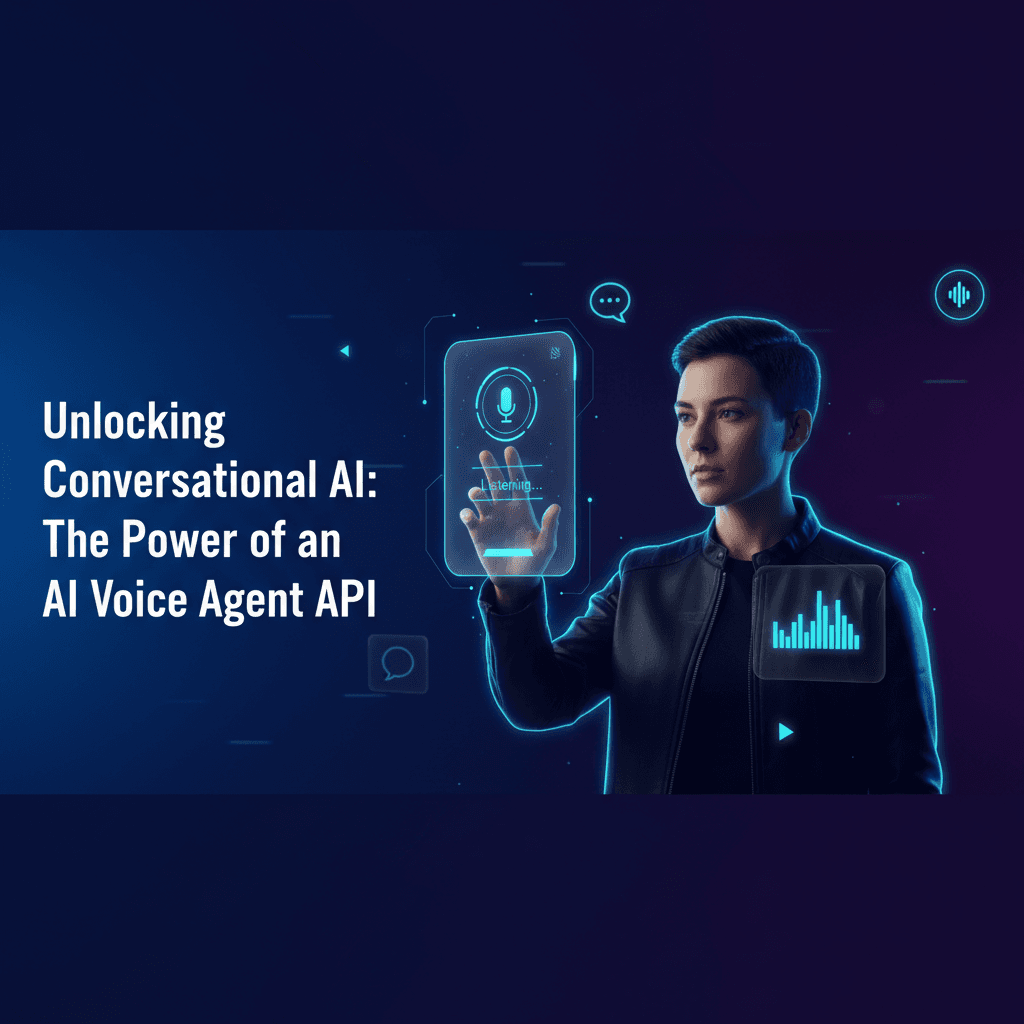
In the rapidly evolving landscape of artificial intelligence, the ability for machines to communicate naturally and effectively with humans is paramount. At the heart of this revolution lies the AI voice agent API, a sophisticated technological interface that empowers developers to integrate advanced conversational AI capabilities into their applications. Gone are the days of disjointed systems; modern APIs are ushering in an era of seamless, real-time, and highly intelligent voice interactions.
What is an AI Voice Agent API?
An AI voice agent API serves as a bridge, connecting your applications with powerful AI models capable of understanding, processing, and generating human-like speech. Unlike traditional voice services that might require separate integrations for Speech-to-Text (STT), Large Language Models (LLM), and Text-to-Speech (TTS), the latest generation of these APIs offers a unified, often single websocket voice agent API solution. This integration significantly simplifies development, reduces latency, and enhances the overall user experience.
The Evolution: From Disjointed to Unified
Historically, building a voice agent involved orchestrating multiple components: a Speech-to-Text (STT) engine to transcribe user speech, an LLM to understand intent and generate a response, and a Text-to-Speech (TTS) engine to vocalize that response. This multi-step process often introduced noticeable delays and complexity. The modern voice agent API with STT LLM TTS integration streamlines this entire pipeline, offering a cohesive and efficient solution.
Key Features Defining the Best AI Voice Agent APIs in 2026
As we look towards the future, several critical features distinguish the leading best voice agent API 2026 contenders:
Real-time and Low Latency Interaction
For truly natural conversations, delays are unacceptable. A top-tier real-time voice agent API minimizes the time between a user speaking and the agent responding, often achieving sub-200ms latency. This is crucial for applications like customer support and phone agents, where smooth, uninterrupted dialogue is essential. The focus is on a speech-to-speech voice agent API experience that feels as natural as talking to another human.
Conversational AI and Barge-in Support
A truly intelligent conversational AI voice agent API doesn't just respond; it understands context, manages turns, and allows for natural interruptions. Voice agent API with barge-in support enables users to speak over the AI agent, just as they would in a human conversation, without the agent finishing its sentence. This significantly improves the fluidity and efficiency of interactions, especially for a voice agent API for phone agents.
Tool Calling and Advanced Functionality
Beyond simple question-answering, modern AI voice agents can perform actions. A voice agent API with tool calling allows the AI to interact with external systems, such as booking appointments, retrieving database information, or processing transactions. This elevates the agent from a mere conversational partner to a functional assistant, making it invaluable for an enterprise voice agent API.
Turn Detection and Context Awareness
Effective conversational flow relies on knowing when a user has finished speaking and when it's the AI's turn to respond. A voice agent API with turn detection accurately identifies these conversational boundaries, ensuring smooth transitions and preventing awkward overlaps or silences. This, combined with robust context awareness, allows for more meaningful and productive interactions.
Use Cases for AI Voice Agent APIs
The applications for a robust AI voice agent API are vast and growing:
Customer Support and Service
One of the most impactful areas is voice agent API for customer support. These agents can handle routine inquiries, provide instant answers to FAQs, guide users through processes, and even resolve complex issues by integrating with CRM systems. This frees up human agents for more nuanced tasks and provides 24/7 support.
Telephony and Contact Centers
For businesses relying on phone interactions, a voice agent API for phone agents can transform the contact center experience. From intelligent IVR systems to proactive outreach, these APIs enable natural, efficient conversations that improve customer satisfaction and reduce operational costs.
Virtual Assistants and Smart Devices
From smart home devices to enterprise virtual assistants, the ability to engage in natural language conversations is key. A low-latency voice agent API ensures these interactions are responsive and helpful, making technology feel more intuitive and integrated into daily life.
Choosing the Right AI Voice Agent API
When selecting an AI voice agent API, consider factors like latency, accuracy of STT and TTS, language support, scalability, and pricing models. Providers like OpenAI voice agent API, Deepgram voice agent API, AssemblyAI voice agent API, and Azure Voice Live API are at the forefront, each offering unique strengths. Some newer players like Grok voice agent API are also emerging with innovative approaches.
It's also important to evaluate the voice agent API pricing structure. While some offer a free AI voice agent API tier for testing, most robust solutions for enterprise use will involve usage-based costs. Look for clear documentation, strong community support, and robust security features.
Conclusion
The AI voice agent API is not just a tool; it's a gateway to a more intuitive and efficient future for human-computer interaction. By embracing these advanced APIs, developers and businesses can create truly transformative conversational experiences that delight users and drive operational excellence. The shift towards unified, real-time, and intelligent voice agents is undeniable, marking a significant milestone in the journey of artificial intelligence.
FAQ: AI Voice Agent API
What is the primary benefit of a single websocket voice agent API?
The primary benefit is significantly reduced latency and simplified development. Instead of managing separate connections for Speech-to-Text (STT), Large Language Models (LLM), and Text-to-Speech (TTS), a single websocket handles the entire conversational flow in real-time, leading to a much smoother and more natural user experience.
How does 'barge-in support' improve conversational AI?
Barge-in support allows users to interrupt the AI agent while it's speaking, just like in a human conversation. This prevents the user from having to wait for the agent to finish its turn, making interactions feel more natural, efficient, and less frustrating, especially in fast-paced scenarios like customer support calls.
Can an AI voice agent API integrate with existing enterprise systems?
Absolutely. Modern enterprise voice agent API solutions often feature 'tool calling' capabilities. This allows the AI agent to invoke functions or APIs of external systems, such as CRM platforms, databases, scheduling tools, or e-commerce platforms, to retrieve information or perform actions on behalf of the user.
Are there free options for an AI voice agent API?
Many providers offer a free AI voice agent API tier or a free trial period. These free options typically come with usage limits (e.g., a certain number of minutes per month) and are ideal for developers to test the API, build prototypes, or for applications with very low usage. For production-level or high-volume use, paid plans are generally required.