



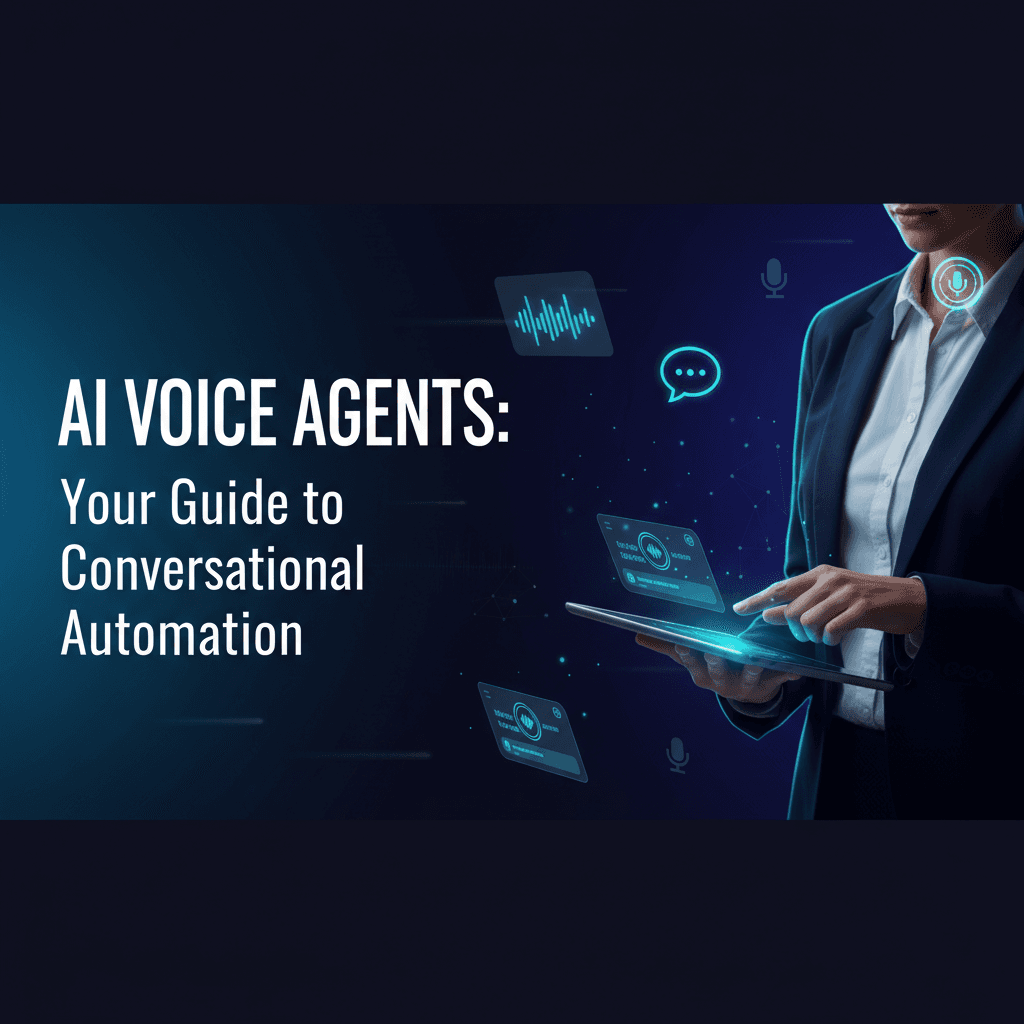
In today's fast-paced digital world, businesses are constantly seeking innovative ways to enhance customer experience and streamline operations. Enter the AI voice agent – a revolutionary technology transforming how we interact with machines. Far beyond simple chatbots, these intelligent systems offer dynamic, human-like conversations, providing instant support and automating complex tasks. But what exactly is an AI voice agent, how do they work, and what benefits can they bring to your organization? This comprehensive guide will delve into the intricacies of AI voice agents, exploring their core technologies, diverse applications, and what to look for in an AI voice agent platform.
What is an AI Voice Agent?
An AI voice agent is an artificial intelligence program designed to interact with users through spoken language. Unlike traditional interactive voice response (IVR) systems that rely on rigid menus, AI voice agents leverage advanced AI capabilities to understand, process, and respond to natural human speech. They can handle a wide range of inquiries, provide information, complete transactions, and even learn from interactions to improve their performance over time. Think of them as sophisticated virtual assistants capable of holding intelligent conversations.
How AI Voice Agents Work: The Core Technologies
Understanding how AI voice agents work involves looking at several interconnected technologies that enable seamless spoken communication:
Speech Recognition (Automatic Speech Recognition - ASR)
This is the foundational technology that converts spoken words into text. Speech recognition for voice agents is crucial for the AI to understand what the user is saying. Advanced ASR systems can handle various accents, dialects, and background noise, making the interaction more robust and reliable.
Natural Language Processing (NLP)
Once speech is converted to text, natural language processing voice agent technology comes into play. NLP allows the AI to understand the meaning, intent, and context of the user's query. It identifies keywords, extracts entities, and interprets the sentiment behind the words, enabling a truly intelligent response.
Natural Language Generation (NLG)
After processing the user's request, the AI needs to formulate a coherent and relevant response. NLG is responsible for generating human-like text responses based on the AI's understanding and knowledge base.
Text-to-Speech (TTS)
Finally, the generated text response is converted back into spoken audio using text-to-speech for AI voice agents. Modern TTS engines produce highly natural-sounding voices, often with customizable tones and accents, enhancing the user experience and making the interaction feel more personal.
Conversational AI
Underpinning these technologies is the broader field of conversational AI voice assistant. This involves designing the dialogue flow, managing context across multiple turns, and integrating with backend systems to retrieve information or perform actions. A sophisticated conversational AI can handle complex, multi-turn conversations and even switch topics fluidly.
Key AI Voice Agent Use Cases and Applications
The versatility of AI voice agents means they can be deployed across numerous industries and functions. Here are some prominent AI voice agent use cases:
AI Voice Agent for Customer Service
This is perhaps the most common application. An AI voice agent for customer service can handle routine inquiries, provide FAQs, check order statuses, and even resolve common issues 24/7. This frees up human agents to focus on more complex, high-value interactions, significantly improving efficiency and customer satisfaction.
Voice AI for Call Center Automation
Beyond basic customer service, voice AI for call center automation can automate entire workflows. This includes intelligent call routing, pre-qualifying leads, gathering information before a human agent takes over, and even performing outbound calls for surveys or reminders. This leads to reduced wait times and operational costs.
AI Phone Agent for Appointment Scheduling
Businesses like healthcare providers, salons, and professional services can leverage an AI phone agent for appointment scheduling. These agents can check availability, book, reschedule, or cancel appointments, and send reminders, all through natural conversation, significantly reducing administrative burden.
Sales and Marketing Support
AI voice agents can qualify leads, answer product-related questions, provide personalized recommendations, and even assist with the sales process, acting as a virtual sales assistant.
Internal HR Support
Employees can get instant answers to HR policy questions, benefits inquiries, or IT support issues, improving internal efficiency.
Benefits of Adopting AI Voice Agents
Implementing AI voice agents offers a multitude of advantages for businesses:
- 24/7 Availability: Provide round-the-clock support, regardless of time zones or holidays.
- Reduced Operational Costs: Automate repetitive tasks, reducing the need for extensive human agent teams.
- Improved Customer Satisfaction: Offer instant responses and personalized interactions, leading to happier customers.
- Scalability: Easily handle fluctuating call volumes without hiring additional staff.
- Consistency: Deliver consistent, accurate information every time.
- Data Insights: Collect valuable data on customer interactions, helping to identify trends and improve services.
- Increased Efficiency: Free up human agents to focus on complex issues, improving overall productivity.
Choosing the Best AI Voice Agent Software
When looking for the best AI voice agent software, consider these critical factors:
- Accuracy of Speech Recognition: How well does it understand different accents and speech patterns?
- Natural Language Understanding (NLU) Capabilities: Can it grasp complex queries and context?
- Naturalness of Text-to-Speech: Does the voice sound human-like and pleasant?
- Integration Capabilities: Can it easily connect with your existing CRM, ERP, or other business systems?
- Customization and Training: Can you train the agent with your specific business data and terminology?
- Multilingual Support: If you serve a global audience, a multilingual AI voice agent is essential.
- Scalability and Reliability: Can the platform handle high call volumes and maintain performance?
- Real-time Voice AI Agent Features: Does it offer immediate processing and response for seamless conversations?
- Deployment Models: Consider whether you need cloud-based, on-premise, or hybrid AI voice agent deployment models.
- Analytics and Reporting: Does it provide insights into agent performance and customer interactions?
- Security and Compliance: Ensure it meets industry standards for data privacy and security, especially for enterprise AI voice agent solutions.
The Future of AI Voice Agents
The evolution of AI voice agents is continuous. We can expect even more sophisticated conversational abilities, deeper integration with emotional intelligence, and hyper-personalized interactions. As the technology matures, real-time voice AI agent capabilities will become even more seamless, blurring the lines between human and AI interactions, and further revolutionizing customer engagement.
Frequently Asked Questions About AI Voice Agents
What is the primary difference between an AI voice agent and a traditional IVR?
Traditional IVR systems rely on pre-recorded prompts and touch-tone inputs or very basic keyword recognition to navigate a rigid menu. An AI voice agent, on the other hand, uses advanced speech recognition and natural language processing to understand and respond to natural, free-form speech, offering a much more fluid and human-like conversational experience.
Can an AI voice agent understand different languages and accents?
Yes, many modern AI voice agent platforms offer robust multilingual AI voice agent capabilities. They are trained on vast datasets that include various languages and accents, allowing them to understand and respond effectively to a diverse user base. The quality can vary between providers, so it's an important factor to evaluate.
Are AI voice agents replacing human customer service representatives?
Not entirely. While AI voice agents can automate many routine and repetitive tasks, they are best seen as augmenting human agents rather than replacing them. They handle the simple inquiries, allowing human representatives to focus on complex problems, empathetic interactions, and situations requiring nuanced judgment, leading to a more efficient and satisfying overall customer service experience.
What industries benefit most from AI voice agent solutions?
Industries with high call volumes, repetitive inquiries, or a need for 24/7 support benefit significantly. This includes telecommunications, banking and finance, healthcare, retail, e-commerce, travel, and hospitality. Any sector looking to improve customer service, automate support, or streamline operations can find value in enterprise AI voice agent solutions.