



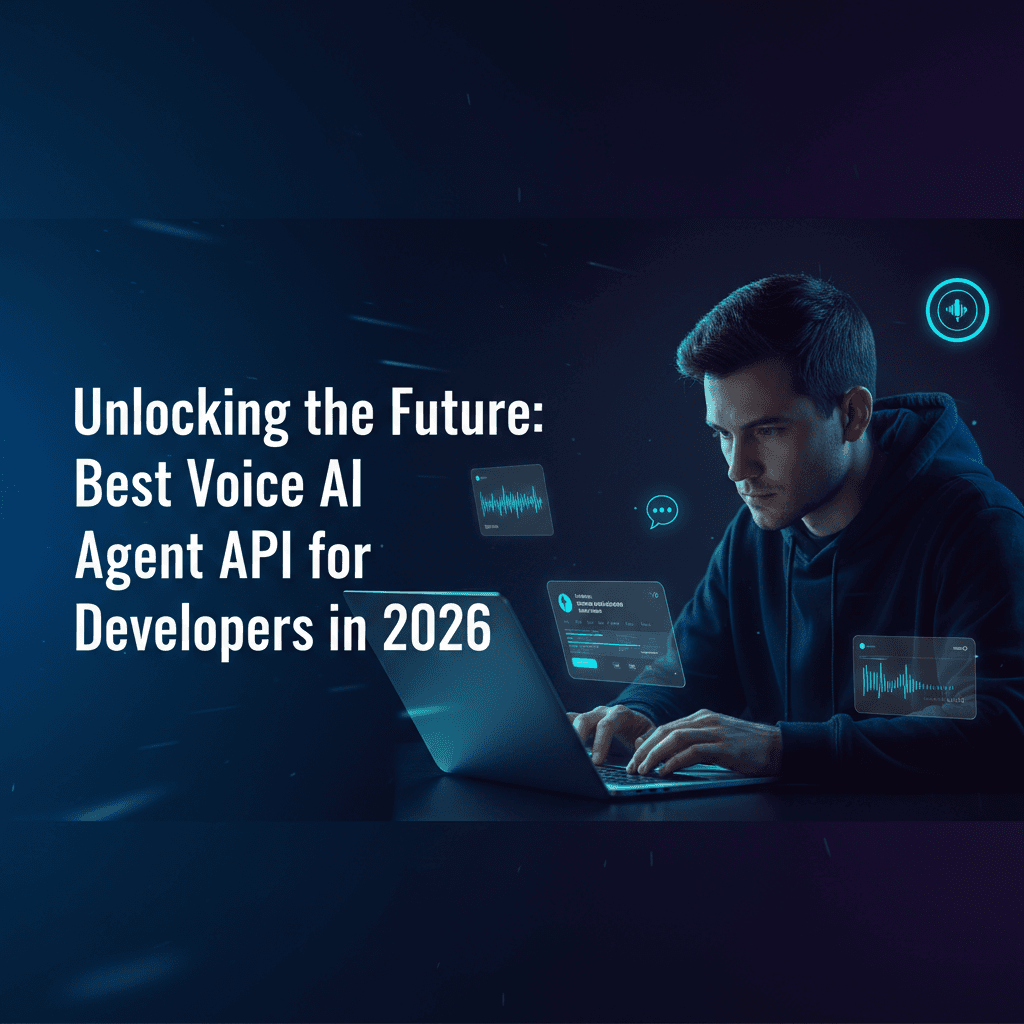
The landscape of artificial intelligence is evolving at an unprecedented pace, and at its forefront is the voice AI agent API. For developers, the ability to integrate sophisticated, real-time voice capabilities into applications is no longer a luxury but a necessity. As we look towards 2026, the demand for robust, low-latency, and highly accurate voice AI solutions will only intensify, particularly in sectors like customer service, virtual assistants, and interactive gaming. This guide delves into the crucial aspects developers need to consider when selecting the best voice AI agent API 2026, focusing on technical specifications, market leaders, and future trends.
The Evolving Landscape of Voice AI Agent APIs
The core of any effective voice AI solution lies in its API. Developers are increasingly seeking a voice agent API for developers that offers not just speech-to-text and text-to-speech, but also advanced features like speaker diarization, sentiment analysis, and natural language understanding (NLU). The shift is towards comprehensive platforms that can handle complex conversational flows with minimal latency, making real-time voice agent API capabilities paramount.
Key Technical Considerations for Developers
When evaluating a programmable voice agent API, several technical aspects stand out:
- Low Latency: For truly interactive experiences, low latency voice agent API is non-negotiable. This often involves WebSocket support and optimized backend infrastructure to ensure near-instantaneous responses.
- Accuracy (WER): Word Error Rate (WER) is a critical metric. Developers need APIs that boast industry-leading accuracy, especially for diverse accents and noisy environments.
- Scalability: The API must be able to handle fluctuating loads, from a few concurrent users to thousands, without performance degradation.
- Language Support: Broad language and dialect support is crucial for global applications.
- Customization: The ability to fine-tune models with custom vocabulary and acoustic models can significantly improve performance for specific use cases.
Leading Voice AI Agent API Providers for 2026
As we approach 2026, several platforms are emerging as frontrunners, offering robust solutions for conversational AI voice agent API development:
AssemblyAI Voice Agent API
AssemblyAI has established itself as a powerful player, particularly for its advanced speech-to-text capabilities and real-time transcription. The AssemblyAI voice agent API is known for its high accuracy and comprehensive feature set, including speaker diarization, sentiment analysis, and content moderation. Their focus on developer-friendly APIs and robust documentation makes them a strong contender for complex voice applications.
Deepgram Voice Agent API
Deepgram stands out with its emphasis on speed and accuracy, particularly in speech to speech voice agent API scenarios. Their end-to-end deep learning approach allows for extremely low latency and high-fidelity transcriptions. The Deepgram voice agent API is highly customizable, allowing developers to train models on their specific data for even greater accuracy, making it ideal for specialized applications and enterprise voice agent API solutions.
OpenAI Realtime Voice Agent API (Whisper & TTS)
OpenAI's offerings, particularly their Whisper model for speech-to-text and their advanced Text-to-Speech (TTS) capabilities, are becoming increasingly vital. The OpenAI realtime voice agent API provides developers with access to highly sophisticated models that excel in understanding and generating natural-sounding speech, making it a powerful tool for building intelligent conversational agents.
VAPI Voice Agent Orchestration
Beyond individual API providers, platforms like VAPI voice agent orchestration are gaining traction. VAPI acts as an intelligent layer that connects various voice AI services, allowing developers to combine the best features of different providers (e.g., Deepgram for STT, OpenAI for NLU, and a custom TTS engine) into a single, cohesive voice agent. This orchestration capability is crucial for building highly specialized and resilient voice applications.
Voice AI Agent API for Call Centers
The impact of voice AI agent APIs on customer service is transformative. A dedicated voice AI API for call centers can automate routine inquiries, provide real-time agent assistance, and analyze customer sentiment, leading to improved efficiency and customer satisfaction. The ability to integrate these APIs seamlessly into existing CRM and contact center platforms is a key differentiator.
Voice AI Agent Integration Guide
Integrating a voice AI agent API typically involves:
- API Key Management: Securely handling API keys for authentication.
- SDKs and Libraries: Utilizing provided SDKs for various programming languages to simplify integration.
- WebSocket Connections: For real-time applications, establishing and managing WebSocket connections for continuous audio streaming.
- Error Handling: Implementing robust error handling and retry mechanisms.
- Data Privacy and Security: Ensuring compliance with data privacy regulations (e.g., GDPR, HIPAA) when processing voice data.
A comprehensive voice AI agent integration guide from the chosen provider is invaluable for developers to quickly get started and troubleshoot issues.
Voice Agent API Pricing Comparison
When selecting an API, a thorough voice agent API pricing comparison is essential. Pricing models vary significantly, often based on factors like:
- Usage: Per-minute or per-second of audio processed.
- Features: Additional costs for advanced features like speaker diarization or NLU.
- Volume Discounts: Tiered pricing for high-volume users.
- Support: Premium support packages.
Developers should carefully analyze their projected usage and feature requirements to choose the most cost-effective solution without compromising on quality or performance.
Conclusion
The future of voice AI is bright, and the tools available to developers are becoming increasingly powerful and sophisticated. By 2026, the emphasis will be on highly accurate, low-latency, and customizable voice AI agent APIs that can be seamlessly integrated into a wide array of applications. Whether you opt for a unified platform like AssemblyAI or Deepgram, or leverage an orchestration layer like VAPI, understanding the technical nuances and conducting a thorough evaluation will be key to building next-generation conversational experiences.
Frequently Asked Questions (FAQ)
What is a voice AI agent API?
A voice AI agent API (Application Programming Interface) allows developers to integrate advanced voice capabilities, such as speech-to-text, text-to-speech, and natural language understanding, into their applications. This enables the creation of intelligent conversational agents that can interact with users via voice.
Why is low latency crucial for voice AI agents?
Low latency is crucial for voice AI agents to provide a natural and seamless conversational experience. High latency can lead to awkward pauses, interruptions, and a frustrating user experience, making real-time interaction difficult. For applications like call centers or virtual assistants, near-instantaneous responses are essential.
How do I choose the best voice AI agent API for my project?
Choosing the best voice AI agent API depends on your project's specific needs. Consider factors like accuracy (WER), latency, scalability, language support, customization options, and pricing. Evaluate providers like AssemblyAI, Deepgram, and OpenAI, and consider orchestration platforms like VAPI for combining services. Always test different APIs with your specific audio data to assess performance.
What is voice agent orchestration?
Voice agent orchestration refers to the process of combining and managing multiple voice AI services (e.g., different speech-to-text engines, NLU models, and text-to-speech voices) through a single platform or API. This allows developers to leverage the strengths of various providers and create more sophisticated and customized voice agents.