





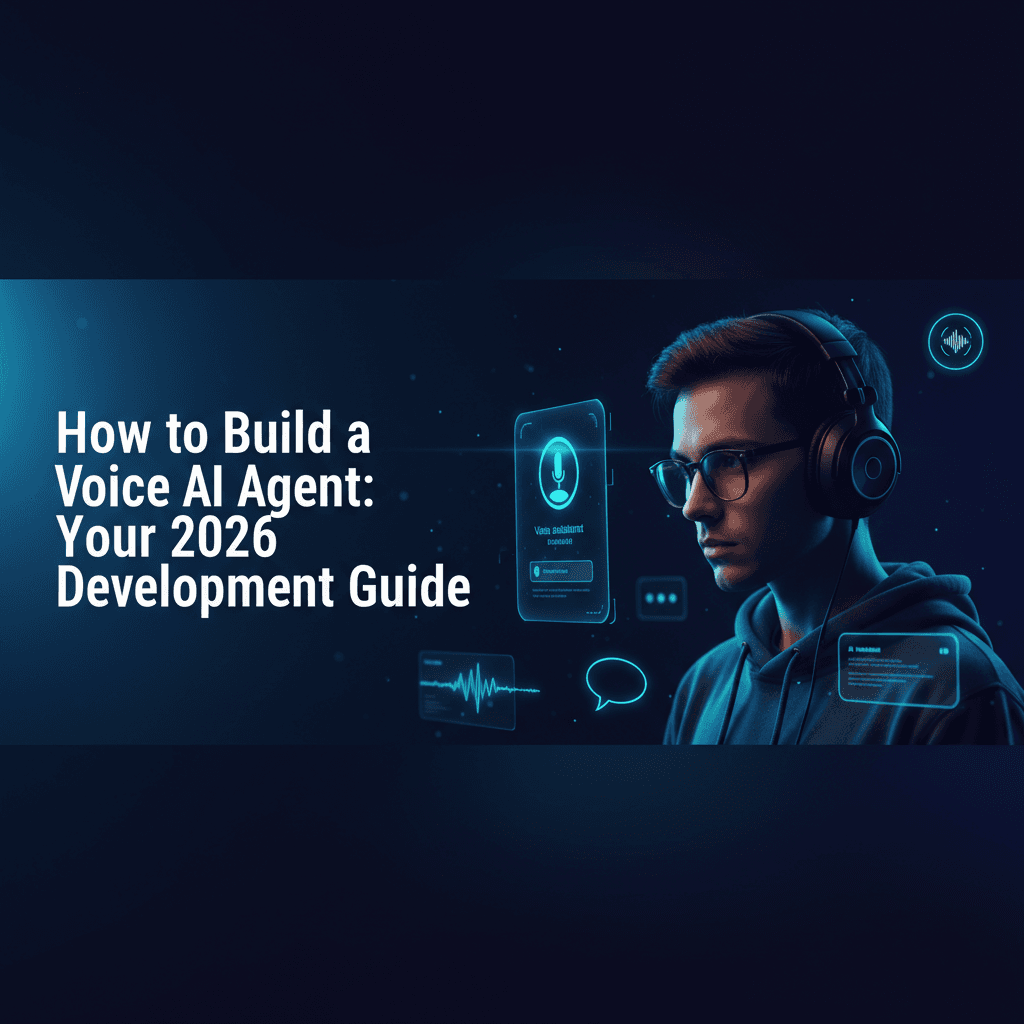
The landscape of artificial intelligence is rapidly evolving, and voice AI agents are at the forefront of this revolution. From automating customer support to personalizing user experiences, the ability to build a voice AI agent is becoming an indispensable skill for developers and businesses alike. This comprehensive guide will walk you through the essential steps, tools, and considerations for developing powerful, intelligent voice agents in 2026 and beyond. Whether you're looking to create an AI voice agent for business or simply curious about how to build a voice AI agent from scratch, you've come to the right place.
Understanding the Core Components of a Voice AI Agent
Before diving into the practicalities of how to build a voice AI agent, it's crucial to understand the fundamental building blocks. A sophisticated voice AI agent typically comprises several key components working in harmony:
1. Speech-to-Text (STT)
This component converts spoken language into written text, allowing the AI to understand user input. Accuracy and latency are critical here, especially for real-time interactions.
2. Natural Language Understanding (NLU)
Once speech is transcribed, NLU processes the text to extract meaning, identify user intent, and recognize entities (like names, dates, or product codes). This is where the AI truly comprehends what the user wants.
3. Dialogue Management
This component manages the flow of the conversation, tracking context, deciding the next best action, and formulating appropriate responses. It's the brain of the conversational agent.
4. Text-to-Speech (TTS)
Finally, TTS converts the AI's textual response back into natural-sounding speech. The quality of the voice, intonation, and emotional nuance can significantly impact user experience. Tools like ElevenLabs excel in this area, offering highly realistic and customizable voices.
Step-by-Step Guide to Building Voice AI Agents
Let's outline the general process for how to build a voice AI agent, from conception to deployment.
Step 1: Define Your Agent's Purpose and Scope
What problem will your voice AI agent solve? Are you looking to create an AI voice agent for business, such as customer support, lead qualification, or internal assistance? Clearly defining the use case will guide your entire development process. For instance, deploying a voice AI agent for customer support will have different requirements than a personal assistant.
Step 2: Choose Your Development Approach
This is where you decide if you want to build a voice AI agent from scratch, use a low-code/no-code platform, or leverage existing APIs.
No-Code/Low-Code Solutions
For those who want to build a no-code voice AI agent, platforms like Google Dialogflow, Amazon Lex, or specialized low-code voice AI agent platforms offer intuitive interfaces to design conversational flows without extensive coding. These are excellent for rapid prototyping and simpler use cases.
API-First Development
For more control and customization, you can integrate various APIs. For example, you can build a voice AI agent with ElevenLabs for high-quality TTS, and use Vapi API for real-time voice interaction and orchestration. Vapi, in particular, simplifies the complex real-time audio streaming and processing required for truly interactive voice agents, allowing you to focus on the conversational logic. You can also build a voice AI agent with LiveKit for real-time communication infrastructure.
Custom Development (e.g., Python)
If you prefer maximum flexibility, you can build a voice AI agent using Python. Libraries like SpeechRecognition for STT, NLTK or SpaCy for NLU, and gTTS or pyttsx3 for basic TTS can be combined. For advanced capabilities, you'd integrate with cloud-based services (Google Cloud Speech-to-Text, AWS Polly, OpenAI's models) via their Python SDKs. There are also many open source voice AI agent tutorial resources available for this approach.
Step 3: Design the Conversational Flow
Map out potential user interactions, intents, and responses. This involves creating dialogue scripts, defining prompts, and handling edge cases. Consider how your agent will greet users, gather information, answer questions, and gracefully end conversations. This is a critical part of the AI voice agent development guide 2026, as user experience heavily relies on natural conversation flow.
Step 4: Integrate Knowledge and Functionality
For your agent to be truly useful, it needs access to information and the ability to perform actions. This means:
- Custom Knowledge Base: Integrate your agent with a custom knowledge base, databases, or CRM systems to provide accurate and personalized information.
- Function Calling: Implement function calling to allow your voice AI agent to interact with external APIs – booking appointments, checking order statuses, or sending emails. This significantly expands the agent's capabilities.
Step 5: Training and Refinement
Train your NLU model with diverse examples of user utterances. Continuously test and refine your agent's responses, intent recognition, and overall conversational flow. User feedback is invaluable here.
Step 6: Deployment and Monitoring
Once your agent is ready, deploy it to your chosen platform – whether that's a website, mobile app, or contact center. Continuously monitor its performance, user interactions, and identify areas for improvement. This is crucial when you deploy a voice AI agent for customer support, where performance directly impacts user satisfaction.
Best Tools to Build a Voice AI Agent in 2026
The market for voice AI tools is booming. Here are some of the best tools to build a voice AI agent:
- ElevenLabs: For cutting-edge, realistic Text-to-Speech (TTS) with emotional nuance. Essential if you want to build a voice AI agent with ElevenLabs for superior voice quality.
- Vapi API: A powerful API for building real-time, human-like voice AI agents. It handles the complex audio streaming, STT, and TTS orchestration, allowing developers to focus on conversational logic. Excellent for those who want to build a voice AI agent with Vapi API.
- LiveKit: An open-source WebRTC platform that provides real-time audio and video infrastructure. Useful if you want to build a voice AI agent with LiveKit for custom real-time communication needs.
- Google Cloud Dialogflow / Amazon Lex: Comprehensive platforms for building conversational interfaces, offering robust NLU and dialogue management.
- OpenAI (GPT models): For advanced natural language understanding, generation, and even function calling capabilities.
- Hugging Face: A hub for open-source NLP models and datasets, invaluable for those looking for an open source voice AI agent tutorial or building custom models.
- Python: The go-to language for AI development, with a rich ecosystem of libraries for every component of a voice AI agent.
AI Voice Agent Development Guide 2026: Key Trends
As we look to 2026, several trends are shaping how we build a voice AI agent:
- Hyper-Personalization: Agents will increasingly adapt to individual user preferences, speaking styles, and even emotional states.
- Multimodal Interactions: Voice agents will seamlessly integrate with visual interfaces, offering a richer user experience.
- Proactive Assistance: Agents will anticipate user needs and offer help before being explicitly asked.
- Ethical AI: A growing emphasis on fairness, transparency, and privacy in voice AI development.
- Edge AI: More processing happening directly on devices, reducing latency and improving privacy.
Conclusion
The journey to build a voice AI agent is exciting and full of potential. By understanding the core components, choosing the right tools, and following a structured development process, you can create powerful conversational experiences that transform how users interact with technology and businesses. Whether you opt for a no-code solution or decide to build a voice AI agent using Python, the future of voice AI is here, and it's more accessible than ever.
Frequently Asked Questions (FAQ)
Q: What is the easiest way to build a voice AI agent?
The easiest way to build a voice AI agent is often by using no-code or low-code platforms like Google Dialogflow or Amazon Lex. These platforms provide pre-built components for STT, NLU, and TTS, allowing you to design conversational flows with minimal coding. Services like Vapi API also simplify the real-time voice interaction layer, making development faster.
Q: Can I build a voice AI agent without coding?
Yes, absolutely! You can build a no-code voice AI agent using platforms specifically designed for this purpose. These platforms typically offer visual drag-and-drop interfaces to define conversational paths, intents, and responses, abstracting away the underlying code complexities.
Q: What are the best tools to build a voice AI agent for business applications?
For business applications, consider tools that offer scalability, robust integrations, and advanced features. Vapi API and ElevenLabs are excellent for real-time, high-quality voice interactions. Google Cloud Dialogflow ES/CX, Amazon Lex, and IBM Watson Assistant provide comprehensive NLU and dialogue management. Integrating with a custom knowledge base and using function calling are also crucial for business-specific tasks.
Q: How important is a custom knowledge base for a voice AI agent?
A custom knowledge base is extremely important, especially for agents designed to answer specific questions or provide detailed information relevant to a particular domain or business. It allows the agent to access and retrieve accurate, up-to-date information that isn't part of its general training data, leading to more helpful and precise responses.
Q: What is 'function calling' in the context of voice AI agents?
Function calling (or tool calling) allows a voice AI agent to interact with external systems and perform actions. When a user makes a request (e.g., "Book me a flight to New York"), the AI agent can identify the intent, extract parameters, and then call a predefined function (like an API endpoint for a flight booking service) to fulfill that request. This capability significantly enhances the agent's utility beyond just answering questions.