




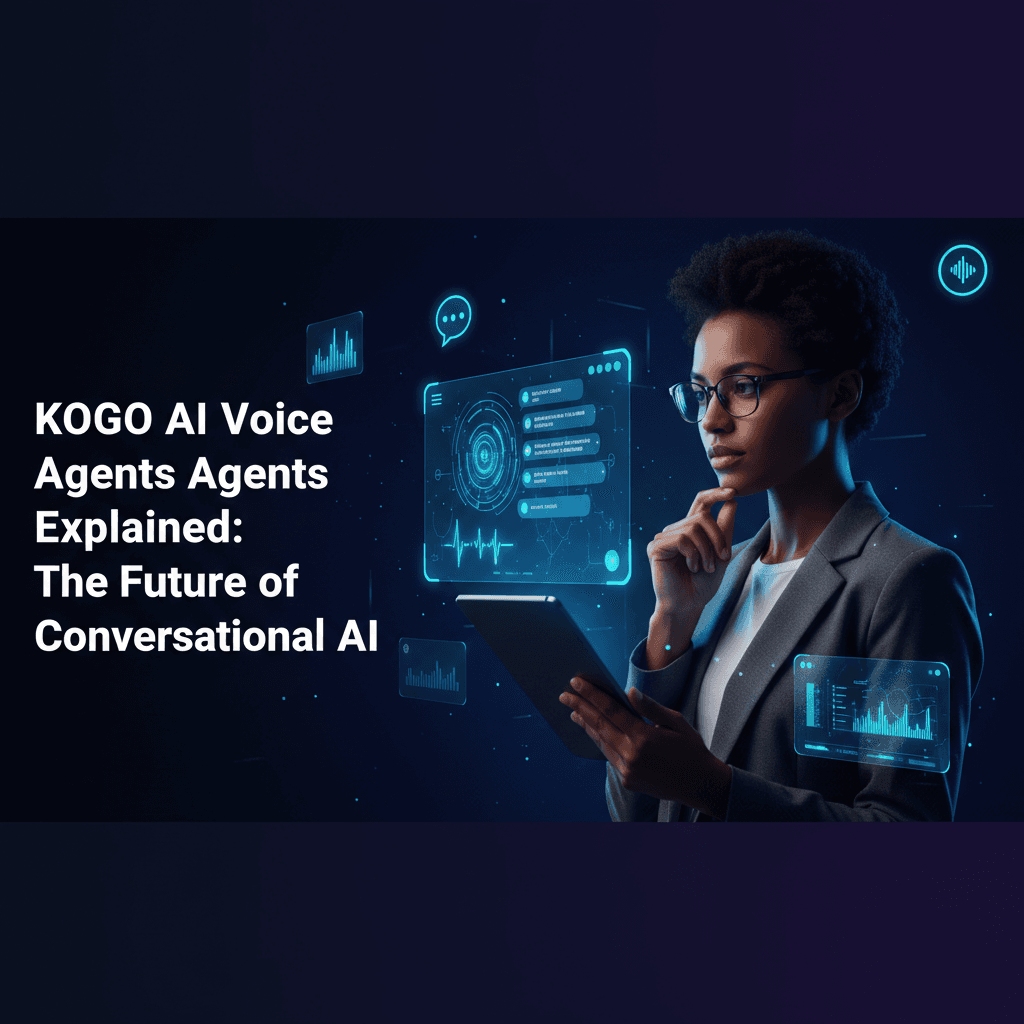
In an increasingly digital world, the demand for seamless and intelligent interactions is paramount. Traditional voice bots often fall short, struggling with complexity and natural conversation. Enter KOGO AI Voice Agents, a groundbreaking solution designed to redefine how businesses engage with their customers and manage operations. This comprehensive guide will provide an in-depth look into KOGO AI Voice AI Agents explained, exploring their core functionalities, unique architecture, and transformative applications across various industries.
What is KOGO AI Voice Agent and How it Works?
At its heart, a KOGO AI Voice Agent is an advanced conversational AI system capable of understanding, processing, and responding to human speech in a highly intelligent and contextual manner. Unlike rigid, rule-based systems, what is KOGO AI Voice Agent and how it works involves a sophisticated blend of artificial intelligence, machine learning, and natural language processing. It leverages an agentic framework, meaning it's designed to act autonomously, make decisions, and complete complex tasks, much like a human agent.
The process begins with the KOGO AI Voice Agent voice-to-text and text-to-speech pipeline explained. When a user speaks, the voice-to-text component accurately transcribes the audio into written text. This text is then fed into the Natural Language Processing (NLP) engine, which interprets the user's intent, extracts key entities, and understands the context of the conversation. Based on this understanding, the agent decides on the appropriate action, which could involve retrieving information, executing a command, or initiating a multi-step automation. Finally, the text-to-speech component converts the agent's response back into natural-sounding speech, completing the conversational loop.
KOGO AI Voice Agent Features Explained: Beyond Basic Interactions
The power of KOGO AI Voice Agents lies in their extensive feature set, meticulously designed to handle real-world complexities:
- Agentic Framework: The KOGO AI Voice Agent agentic framework explained emphasizes autonomy and goal-oriented behavior. Agents can maintain context across multiple turns, adapt to user input, and proactively guide conversations to achieve desired outcomes.
- Natural Language Processing (NLP): The sophisticated KOGO AI Voice Agent natural language processing explained capabilities allow for deep understanding of human language, including nuances, slang, and complex sentence structures, far surpassing traditional keyword-based systems.
- Conversational AI Capabilities: With KOGO AI Voice Agent conversational AI capabilities explained, these agents can engage in highly natural, human-like dialogues, moving beyond simple Q&A to truly interactive and empathetic exchanges.
- Multi-Step Automation: One of the standout features is KOGO AI Voice Agent multi-step automation explained. Agents can orchestrate complex workflows involving multiple steps, integrations, and decision points, automating tasks that would traditionally require human intervention.
- No-Code/Low-Code Platform: The KOGO AI Voice Agent no-code low-code platform explained empowers businesses to build, customize, and deploy agents without extensive programming knowledge, democratizing access to advanced AI. This includes the intuitive KOGO AI Voice Agent Store and Agent Builder explained, where users can find pre-built agents or design their own.
- On-Premises Edge Computing: For industries with strict data privacy or low-latency requirements, KOGO AI Voice Agent on-premises edge computing explained offers the ability to deploy agents directly on local infrastructure, ensuring data security and real-time performance.
KOGO AI Voice Agent vs. Traditional Voice Bots Explained
To truly appreciate the innovation, it's crucial to understand KOGO AI Voice Agent vs traditional voice bots explained. Traditional voice bots are typically script-based, following predefined rules and flowcharts. They struggle with deviations, context switching, and understanding natural, unstructured language. Their responses are often robotic and limited, leading to frustrating user experiences.
KOGO AI Voice Agents, conversely, are intelligent, adaptive, and context-aware. They learn from interactions, can handle ambiguity, and provide personalized responses. Their agentic framework allows them to dynamically adjust to conversational flow, making interactions feel far more natural and efficient. This fundamental difference translates into higher customer satisfaction, reduced operational costs, and the ability to automate more complex tasks.
Real-World Applications: KOGO AI Voice Agent Use Cases for Enterprises Explained
The versatility of KOGO AI Voice Agents makes them invaluable across a multitude of sectors. Here are some prominent KOGO AI Voice Agent use cases for enterprises explained:
- Automotive Industry: The KOGO AI Voice Agent for automotive industry explained showcases its potential in enhancing in-car experiences. From hands-free navigation and infotainment control to vehicle diagnostics and emergency assistance, KOGO agents can provide a safer, more intuitive driving experience. Imagine asking your car, "Find the nearest charging station and pre-condition the battery," and having the agent seamlessly execute these multi-step commands, potentially with KOGO AI Voice Agent integration with MapmyIndia explained for precise location services.
- Customer Service: Automating FAQs, handling routine inquiries, booking appointments, and even triaging complex issues to human agents, significantly improving response times and customer satisfaction.
- Healthcare: Assisting patients with appointment scheduling, medication reminders, answering health-related queries, and providing support for remote monitoring.
- Banking & Finance: Securely handling balance inquiries, transaction history, fund transfers, and fraud alerts, all through natural voice commands.
- Logistics & Supply Chain: Providing real-time updates on shipments, managing inventory, and coordinating deliveries, even in challenging environments where traditional interfaces are impractical.
These agents are not just theoretical; they are tackling KOGO AI Voice Agent real world tasks explained India, demonstrating their efficacy in diverse operational contexts and cultural nuances.
The Future is Conversational with KOGO AI
KOGO AI Voice Agents represent a significant leap forward in conversational AI. By combining advanced NLP, an intelligent agentic framework, and robust deployment options including on-premises edge computing, KOGO is enabling businesses to create truly intelligent, efficient, and engaging voice experiences. As technology continues to evolve, these agents will play an increasingly critical role in shaping how we interact with the digital world, making technology more accessible and intuitive for everyone.
Frequently Asked Questions about KOGO AI Voice Agents
Q: What makes KOGO AI Voice Agents different from chatbots?
A: While both are conversational AI, KOGO AI Voice Agents are designed with an agentic framework, meaning they are more autonomous, can maintain context over longer interactions, and perform multi-step automation. They go beyond simple text-based responses to understand intent and execute real-world tasks, often through voice interfaces, which is a key aspect of KOGO AI Voice AI Agents explained.
Q: Can KOGO AI Voice Agents integrate with existing business systems?
A: Yes, KOGO AI Voice Agents are built for seamless integration. Their architecture supports various APIs and connectors, allowing them to interact with CRM systems, ERPs, databases, and other enterprise applications. This enables them to perform complex KOGO AI Voice Agent multi-step automation explained across different platforms.
Q: Is it possible to deploy KOGO AI Voice Agents on-premises?
A: Absolutely. KOGO AI Voice Agent on-premises edge computing explained is a key offering, allowing businesses to deploy agents directly on their own infrastructure. This is particularly beneficial for industries with strict data privacy regulations or those requiring extremely low-latency responses, as seen in certain KOGO AI Voice Agent for automotive industry explained scenarios.
Q: How does the no-code/low-code platform work for building agents?
A: The KOGO AI Voice Agent no-code low-code platform explained provides an intuitive graphical interface within the KOGO AI Voice Agent Store and Agent Builder explained. Users can drag-and-drop components, define conversational flows, train the NLP model with examples, and configure integrations without writing complex code. This significantly reduces development time and technical barriers for creating powerful agents.
Q: What kind of real-world tasks can KOGO AI Voice Agents handle?
A: KOGO AI Voice Agents can handle a wide array of KOGO AI Voice Agent real world tasks explained India and globally. These include customer support (e.g., order status, FAQs), sales assistance (e.g., product information, lead qualification), operational tasks (e.g., inventory checks, scheduling), and even complex multi-step processes like booking travel or managing smart home devices, thanks to their advanced KOGO AI Voice Agent conversational AI capabilities explained.